Last week we saw that Advent is a season for making sure we are ready. Not just to celebrate Jesus’ first coming at Christmas, but more importantly to be ready for when he returns again to bring both judgement and a new heaven and new earth. During this time we are encouraged to think about whether we are living lives that will please Jesus he returns. One of the questions I said we need to consider is: “Am I using the gifts and talents God gave me as I should?”
Tag Archives: jesus
This Sunday 30th November 2025
Advent is meant to be in part a season to prepare for celebrating Christmas, the festival that marks the Son of God coming among us as a baby. Yet, it is also a time to remember that Jesus will come again
Christ the King (Luke 23:33-43)

“For the Lamb at the centre of the throne will be their shepherd; he will lead them to springs of living water.
And God will wipe away every tear from their eyes.” (Revelation 7:17)
He is also our shepherd. ‘Shepherd’ was a common image in the ancient world for kings. They led the people as a shepherd leads his flocks. In this verse, however, in imagery echoing Psalm 23, we are told that Jesus as our shepherd king will lead us to springs of living water. His rule brings us life, a life where God will wipe every tear from our eyes.
Why not recommit to making Jesus the king of your life, accepting his sacrifice for your sins and allowing him to lead you to eternal life?
This Sunday 23rd November 2025
This coming Sunday is called, ‘Christ the King’. So, what kind of king is Jesus?
Perseverance and Faith (2 Thessalonians 1:1-12)

“We pray this so that the name of our Lord Jesus may be glorified in you, and you in him, according to the grace of our God and the Lord Jesus Christ.” (1 Thes. 1:12)
This week we begin a mini-series on the short letter of 2 Thessalonians.
Repentance and Resentment (Luke 15:11-32)

Luke 15:32: “But we had to celebrate and be glad, because this brother of yours was dead and is alive again; he was lost and is found.”
This week we continue our series on the stories Jesus told, with a look at one of the most famous parables of all, the Parable of the Prodigal Son.
The Rich Fool (Luke 12:13-21)

“For you know the grace of our Lord Jesus Christ, that though he was rich, yet for your sakes he became poor, so that you through his poverty might become rich.” (2 Corinthians 8:9)
True Discipleship (1 Thessalonians 1:1-10)
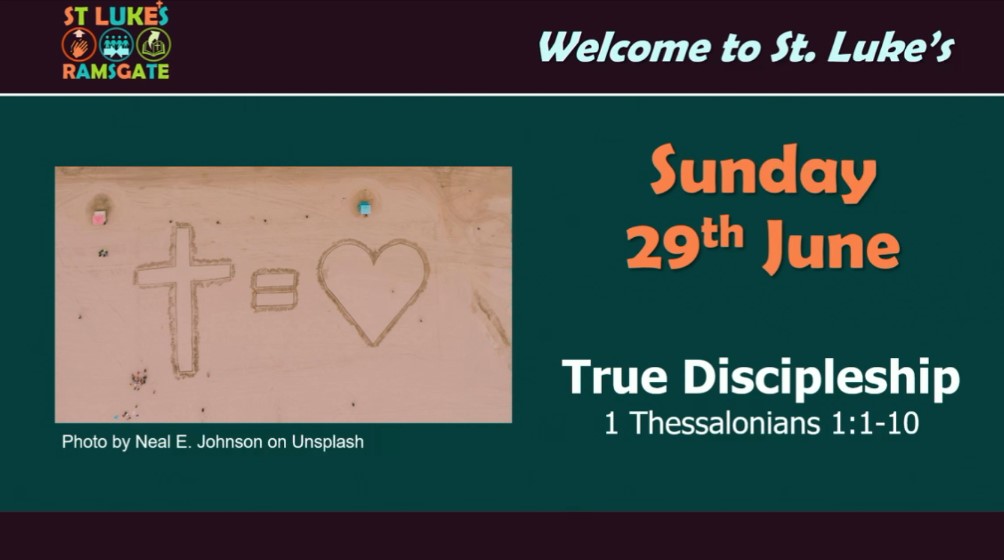
“We remember before our God and Father your work produced by faith, your labour prompted by love, and your endurance inspired by hope in our Lord Jesus Christ.” (1 Thessalonians 1:3)
Why do you do what you do? It is not an easy question to answer. We all have mixed motives for our actions in life, but some will be more important to us than others.
So, what drives your life? A desire to seek pleasure or comfort for yourself? A belief that life will be much better and more secure if only you had more money? Wanting to please others? To look good in front of the crowd? To please a loved one, a boss or someone you admire? Perhaps it is a desire to feel that you have made a success of your life or that you have achieved something meaningful or lasting?
As Paul writes to the baby church in Thessalonica, he starts by giving thanks for what is driving their actions: faith, love and hope. These new Christians have found a new reason for living: Jesus Christ. Knowing that they have been saved through his death and resurrection, they have re-oriented their lives to live for God and to live like Jesus. Their faith has not just changed the way they think it has led to a life of action that is prepared to put in the hard graft and to keep going despite the challenges.
For us this raises two questions: “Does our faith lead to action?” and “Are our actions motivated by our faith?” The more we can honestly say, ‘Yes’ to both these questions, the closer we are to being true disciples of Christ.
God Speaks to Depression (1 Kings 19:1-15a)
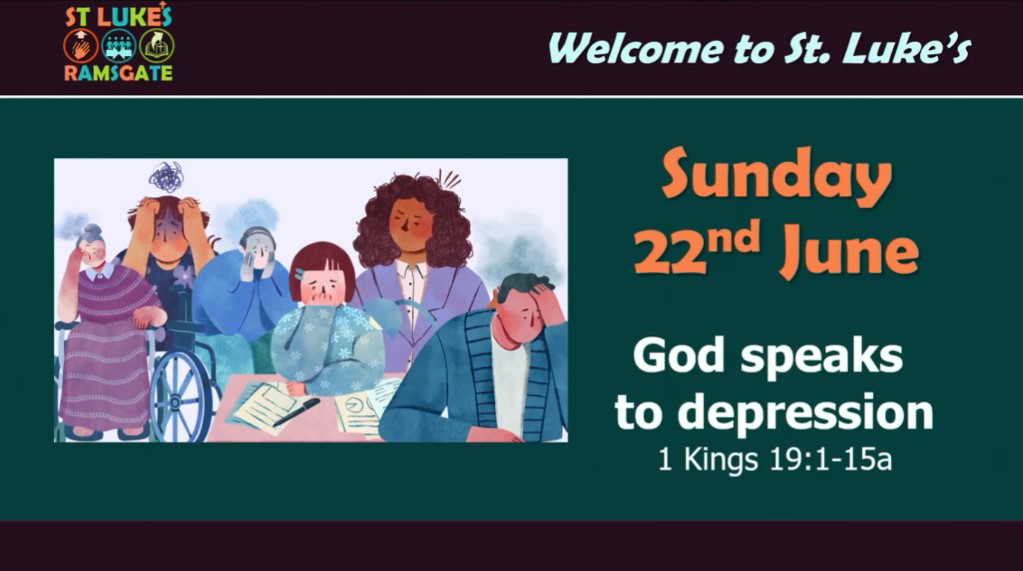
‘After the earthquake came a fire, but the Lord was not in the fire. And after the fire came a gentle whisper.’ (1 Kings 19:12)
We learn more about God’s help for Elijah.
Unity: Babel and Pentecost (Genesis 11:1-9)

Acts 2:4: “All of them were filled with the Holy Spirit and began to speak in other tongues as the Spirit enabled them.”
This week it is Pentecost, when we remember the coming of the Holy Spirit on the church for the first time and the preaching of the gospel in tongues people from all nations could understand. It is also our special gift day, and we encourage regular members to bring their response forms to the Planned Giving Review.
 St. Luke's Church Ramsgate