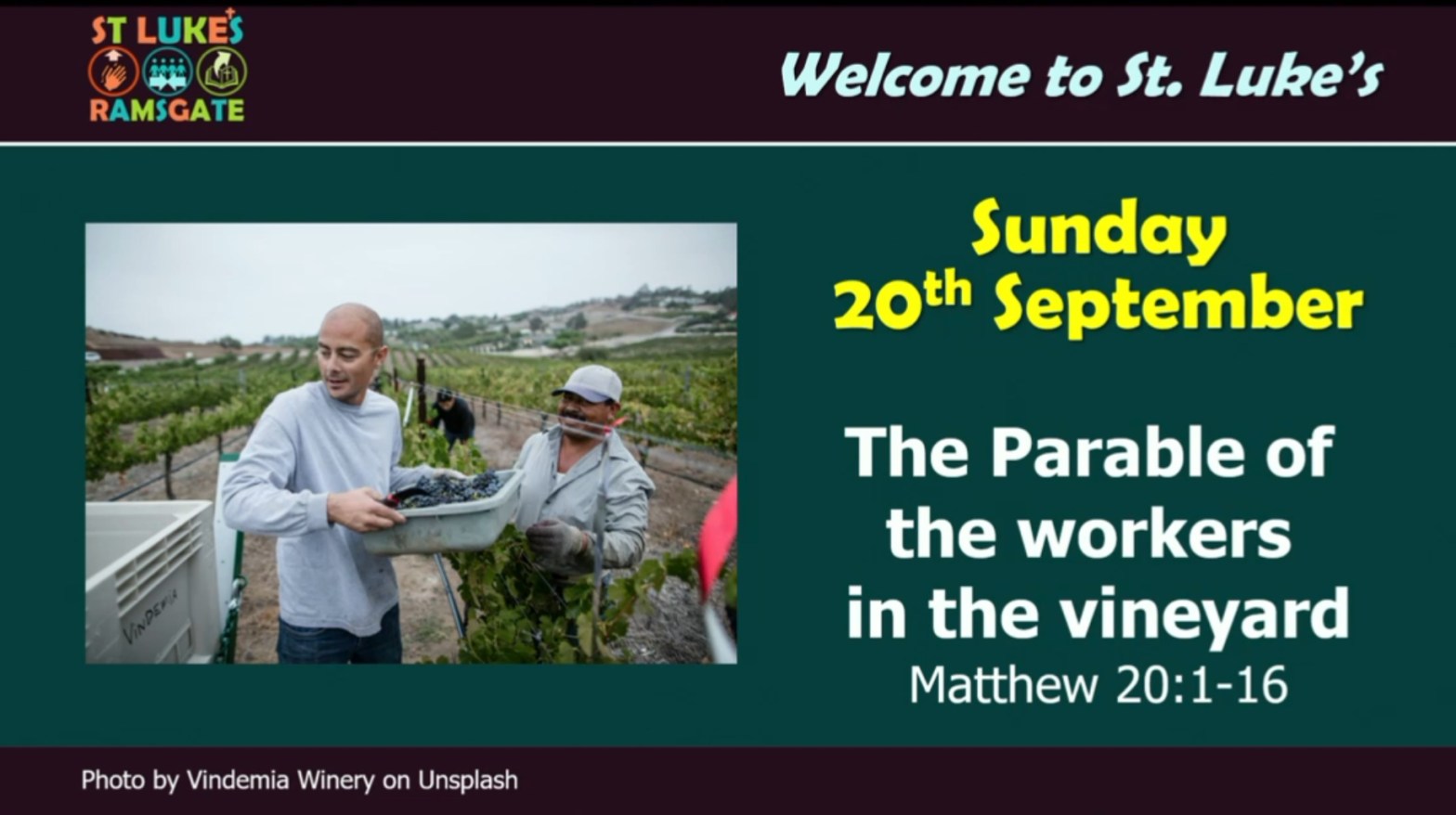
The Parable of the Vineyard Workers (Matthew 20:1-16)

“For it is by grace you have been saved, through faith—and this is not from yourselves, it is the gift of God— not by works, so that no one can boast.” (Ephesians 2:8-9)

Our focus this Sunday is another of Jesus’ Parables from Matthew’s gospel that focuses on the meaning of grace.

The Parable of the Unmerciful Servant (Matthew 18:21-35)

“For if you forgive men when they sin against you, your heavenly Father will also forgive you. But if you do not forgive men their sins, your Father will not forgive your sins.” (Matthew 6:14-15)

This week we look at another of Jesus’ parables in Matthew’s gospels, that tackles the issue of forgiving others.

The Parable of the Lost Sheep (Matthew 18:10-20)

“Jesus said, ‘Truly I tell you, unless you change and become like little children, you will never enter the kingdom of heaven.'” (Matthew 18:3)

The theme for our service is ‘The Parable of the Lost Sheep’ as we begin a series looking at some of the stories Jesus told from Matthew’s gospel.

The Day the Earth Stood Still (Joshua 10:1-14 and Matthew 15:21-28)

“The Son is the image of the invisible God, the firstborn over all creation.” (Colossians 1:15)

The readings from Joshua 10:1-14 and Matthew 15:21-28 describe pivotal moments in the stories of the Old Testament and the New Testament respectively, moments which are of great consequence for us in how we understand what God is doing in the world today.

Joshua’s First Battle (Joshua 5:13-6:27)

“By faith the walls of Jericho fell, after the people had marched around them for seven days.” (Hebrews 11:30)

Joshua defeated Jericho when he was obedient to the strange commands given him by the LORD.

We need to learn obedience to him and trust in him, too, even when to do so seems to go against the logic of a purely earthly based perspective. Joshua and Israel did that and they were victorious. We need to do the same.

Will we look for God at work in our lives and the lives of those around us? Will we prioritise obeying God, even when it feels odd to do so? Will we live as those on the LORD’s side?

Israel’s Faith (Joshua 3-4)

“Praise be to the God and Father of our Lord Jesus Christ! In his great mercy he has given us new birth into a living hope through the resurrection of Jesus Christ from the dead,” (1 Peter 1:3)

Christian hope is not founded on human strength or ability but on God’s power. The book of Joshua recounts the Israelite invasion of the Promised Land. Was this just a match between two human teams? Could victory be guaranteed? Rahab, the Canaanite, was already convinced Israel would win. In Canaanite mythology, the god who controlled the waters, was the supreme god. She had already heard of the crossing of the Red Sea and concluded that the LORD their God was with them (Joshua 2:9-10). But God did it again. He dried up the river Jordan, so that Israel could cross into Canaan. This gave Israel a confident hope. It confirmed to Rahab that her decision to side with the Israelites was the right one.

As Christians, we look not to the promised land, but to eternal life. Not to victory over others, but death. How can we have a confident hope? We look to Jesus, who crossed from death into resurrected life. We trust not in human power, but in the God who has power over the waters and over death.