The theme for this year’s Christmas Publicity is ‘Joy!’ My hope and prayer for all of you reading this, is that you have a truly joyful Christmas. After all, everyone, Christian or not, believes that Christmas is a time to be happy.
Tag Archives: jesus
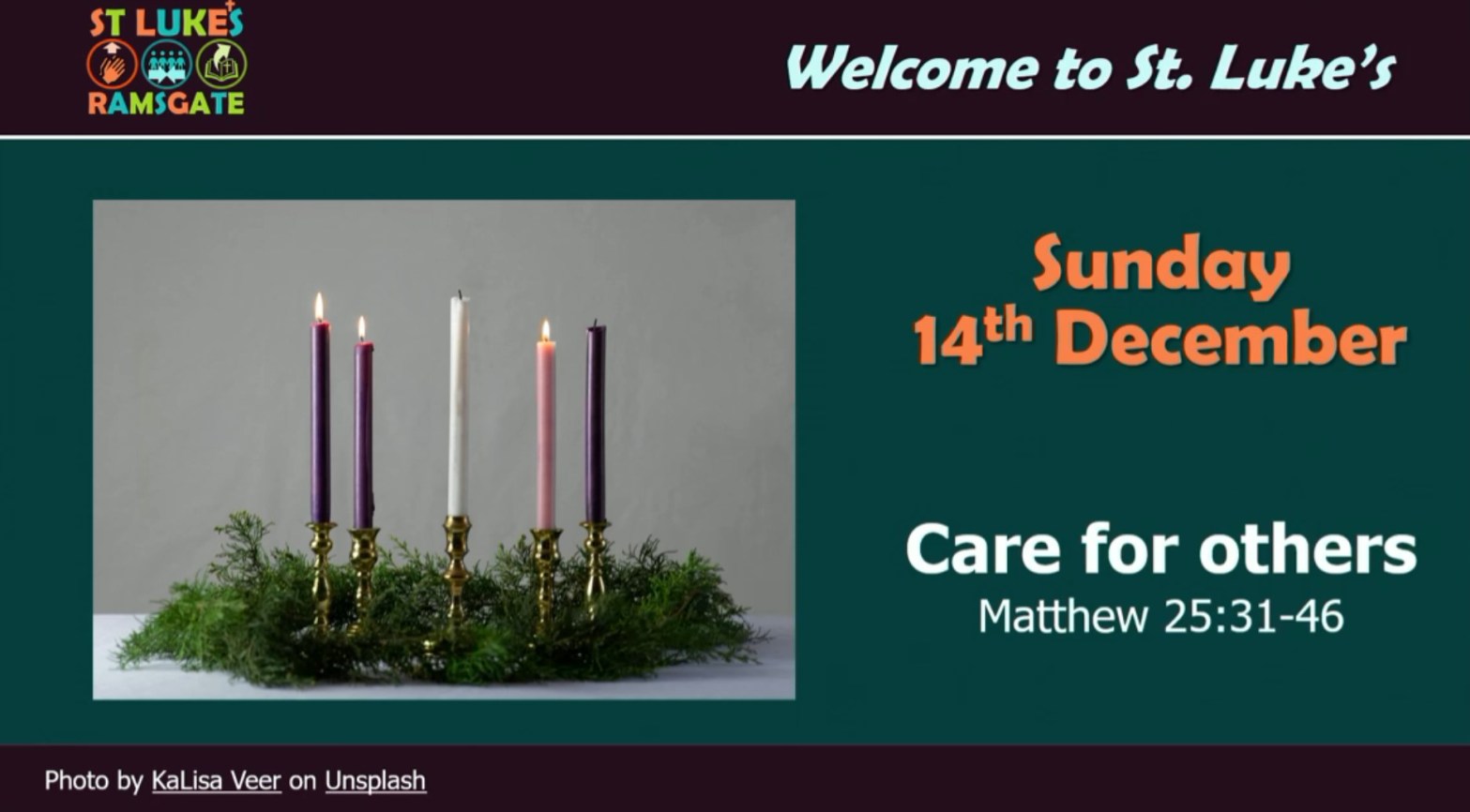
Care for others (Matthew 25:31-46)
“Therefore keep watch, because you do not know on what day your Lord will come.” (Matthew 24:42)
Do we see Jesus when we see someone in need? If we say we are a Christian now, if we believe that Jesus gave his life, so that we can have the hope of eternal life, then how would we not help Jesus in need? Jesus says the way we need to do that is to help those we come across who find themselves in need.
This Sunday 14th December 2025
“Do I treat other people, as though they are Jesus?” This is the thrust of the last of the stories that Jesus tells to help us consider whether we are ready for his return in Matthew 25.
Use your gifts (Matthew 25:14-30)

“Therefore keep watch, because you do not know on what day your Lord will come.” (Matthew 24:42)
Last week we saw that Advent is a season for making sure we are ready. Not just to celebrate Jesus’ first coming at Christmas, but more importantly to be ready for when he returns again to bring both judgement and a new heaven and new earth. During this time we are encouraged to think about whether we are living lives that will please Jesus he returns. One of the questions I said we need to consider is: “Am I using the gifts and talents God gave me as I should?”
This Sunday 7th November 2025
Last week we saw that Advent is a season for making sure we are ready. Not just to celebrate Jesus’ first coming at Christmas, but more importantly to be ready for when he returns again to bring both judgement and a new heaven and new earth. During this time we are encouraged to think about whether we are living lives that will please Jesus he returns. One of the questions I said we need to consider is: “Am I using the gifts and talents God gave me as I should?”
This Sunday 30th November 2025
Advent is meant to be in part a season to prepare for celebrating Christmas, the festival that marks the Son of God coming among us as a baby. Yet, it is also a time to remember that Jesus will come again
Christ the King (Luke 23:33-43)

“For the Lamb at the centre of the throne will be their shepherd; he will lead them to springs of living water.
And God will wipe away every tear from their eyes.” (Revelation 7:17)
He is also our shepherd. ‘Shepherd’ was a common image in the ancient world for kings. They led the people as a shepherd leads his flocks. In this verse, however, in imagery echoing Psalm 23, we are told that Jesus as our shepherd king will lead us to springs of living water. His rule brings us life, a life where God will wipe every tear from our eyes.
Why not recommit to making Jesus the king of your life, accepting his sacrifice for your sins and allowing him to lead you to eternal life?
This Sunday 23rd November 2025
This coming Sunday is called, ‘Christ the King’. So, what kind of king is Jesus?
Perseverance and Faith (2 Thessalonians 1:1-12)

“We pray this so that the name of our Lord Jesus may be glorified in you, and you in him, according to the grace of our God and the Lord Jesus Christ.” (1 Thes. 1:12)
This week we begin a mini-series on the short letter of 2 Thessalonians.
Repentance and Resentment (Luke 15:11-32)

Luke 15:32: “But we had to celebrate and be glad, because this brother of yours was dead and is alive again; he was lost and is found.”
This week we continue our series on the stories Jesus told, with a look at one of the most famous parables of all, the Parable of the Prodigal Son.
 St. Luke's Church Ramsgate