Princess Diana, who herself was known for showing kindness, was reported as saying, “Carry out a random act of kindness, with no expectation of reward, safe in the knowledge that one day someone might do the same for you.” There is truth in this. Kindness often begets kindness, whereas unkindness spawns more unkindness. As Christians, however, we are not motivated to show kindness in the hope that it will rebound on us, but because God, our Father has already shown kindness to us.
Tag Archives: god
This Sunday- 26th April 2026
We live in a world where we can order almost anything more or less instantly on our phone or even through our smart speaker. In the past you would find things out by going to the library and trawling through books. Now you just ask google. We live in an instant world, where we don’t expect to wait for long and so we are not trained in patience.
This Sunday- 19th April 2026
There is no livestream or service at St. Luke’s.
However, there is lots happening at St. George’s. Lots of fun and a great opportunity for us as a church to connect with the wider town community and show our desire to serve the town.
Doubting Thomas (John 20:19-31)
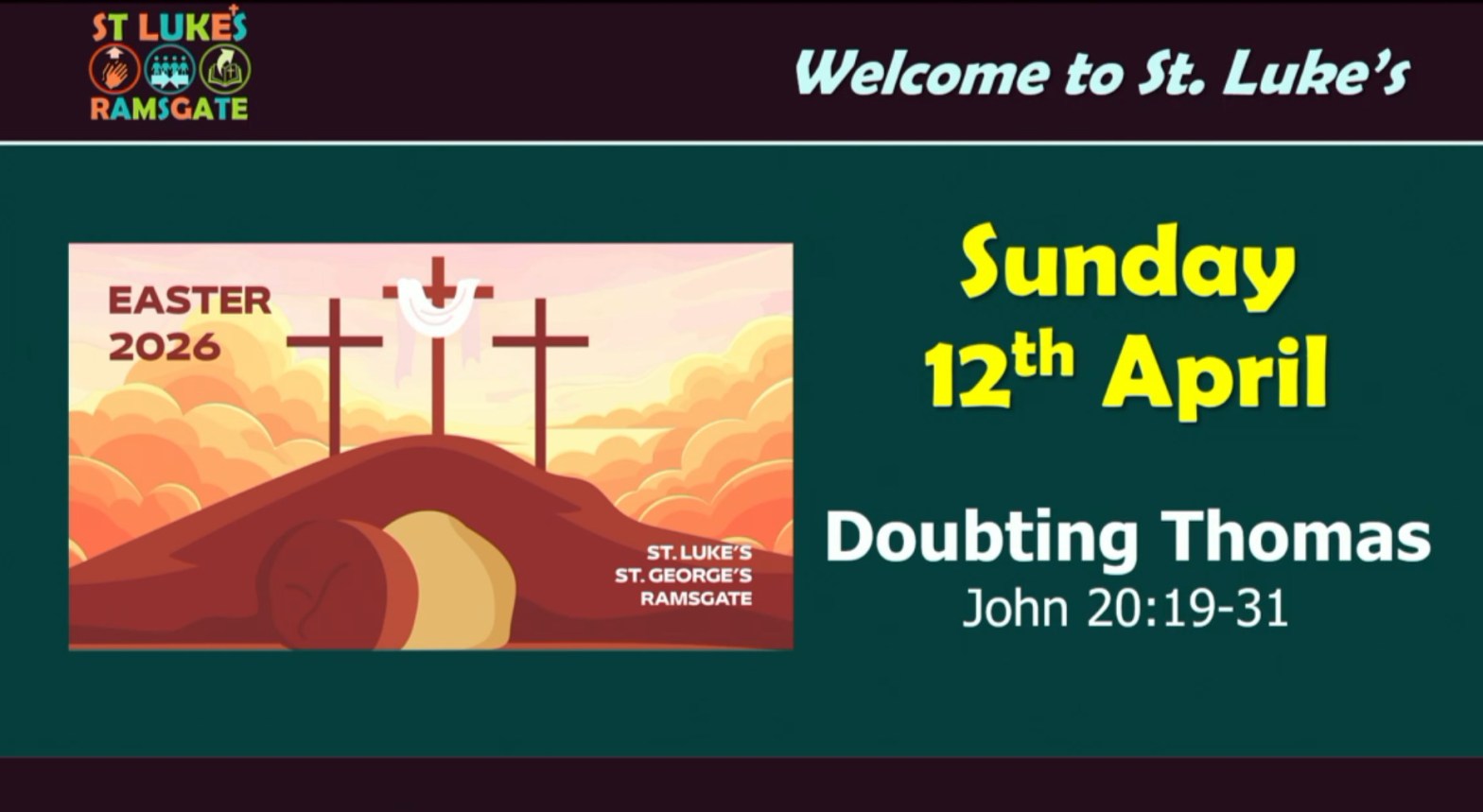
“Then Jesus said to Thomas: “”Because you have seen me, you have believed; blessed are those who have not seen and yet believe.””” (John 20:29)
This week we continue the Easter resurrection theme and look at the part Thomas played.
This Easter- 2nd to 12th April 2026
The Easter Story is an emotional rollercoaster. It takes us from the depths of human cruelty and agony to the highs of the most incredible and hope-giving miracle.
This Sunday- 29th March 2026
As part of her preparation to be enthroned as Archbishop, Sarah Mullally chose to walk a 72 mile pilgrimage from St. Paul’s, Cathedral in her previous Diocese of London, to the Cathedral church of her new Diocese in Canterbury. One thing she didn’t do was ride a donkey!
Peace (Philippians 4:2-9)
“Blessed are the peacemakers, because they will be called children of God.” (Matthew 5:9)
When Paul writes about ‘the peace of God’, he does so in the context of urging Christians in the Philippian church to stop arguing (Philippians 4:2-3). In other words, Paul recognises that it is easier to find peace with each other, when we have first grasped the peace of God in our lives. Indeed, relationship breakdowns and even wars often arise out of contexts of deep anxiety.
To be a peacemaker, is to follow Christ’s example. He came to die for us, so that we could have peace with God. But also to be a peacemaker requires us to be free from anxiety, to not just have peace with God, but also the peace of God in our lives. Out of that God given peace we are equipped to work for peace.
This Sunday- 22nd March 2026
How can we find inner peace in a world of war and sickness?
Love (1 John 4:7-12)
“This is love: not that we loved God, but that he loved us and sent his Son as an atoning sacrifice for our sins.” (1 John 4:10)
This weekend is Mothering Sunday, when we celebrate and give thanks for the love of our mothers. The relationship between a mother and her child is perhaps the strongest of all human bonds, forged as it is in nine months of pregnancy, the pain of childbirth itself and the intimate care of a newborn child. It is a relationship marked by a sacrificial gracious love.
Much of this mirrors God’s love for us. Out of love, he sent His Son to die for our sins and out of love he offers us the gift of forgiveness and eternal life.
So, let’s give thanks for our mothers and their love, whilst also remembering God’s love for us. As we do so, let’s learn to love others in the same way.
This Mothering Sunday- 15th March 2026
This weekend is Mothering Sunday, when we celebrate and give thanks for the love of our mothers.

