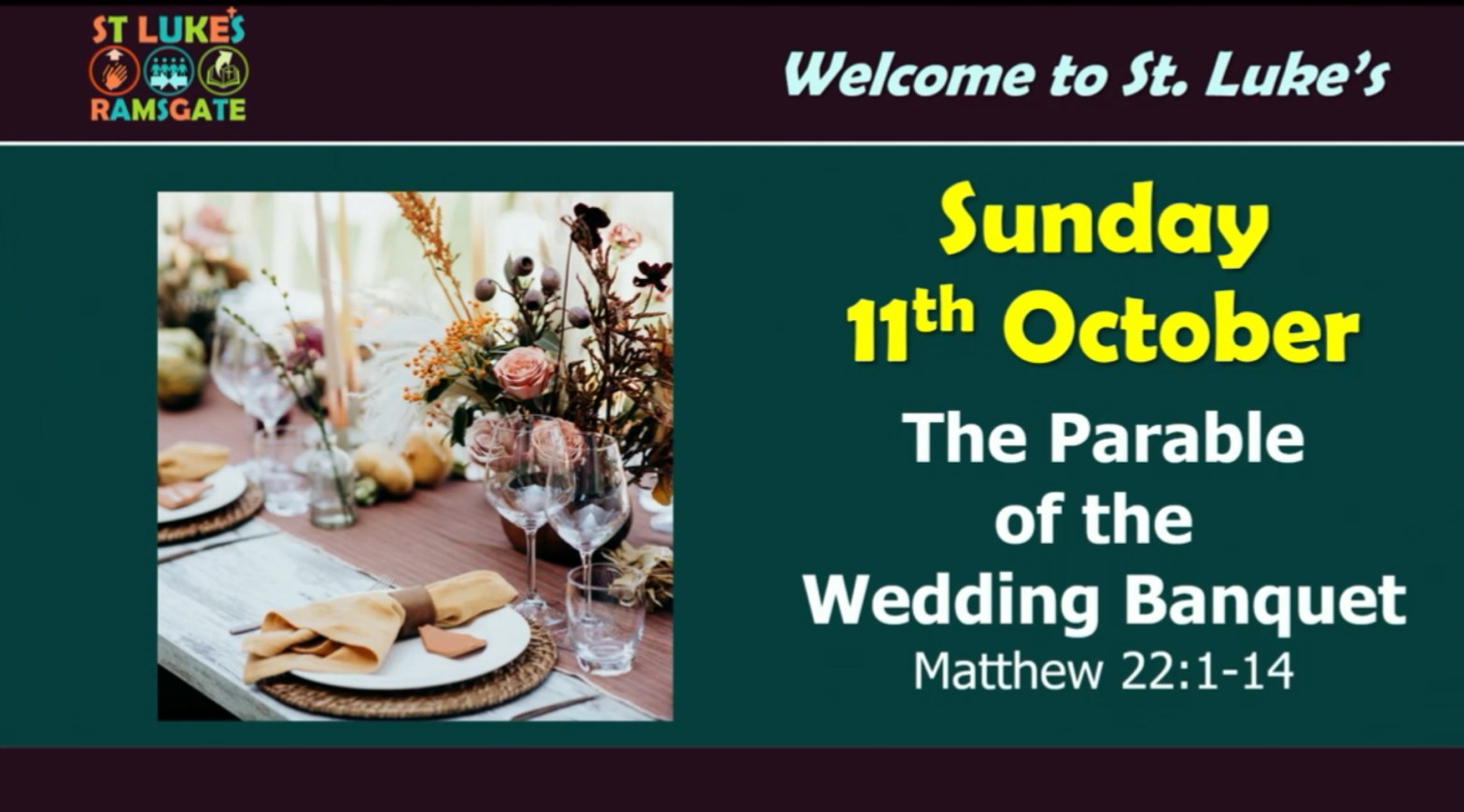
“Come, all you who are thirsty, come to the waters; and you who have no money, come, buy and eat! Come, buy wine and milk without money and without cost.” (Isaiah 55:1)
We finish our series on the Parables in Matthew’s gospel with the Parable of the Wedding Banquet.The invitation to the banquet is free to all. Accepting it is transformational.
The Parable of the Wedding Banquet (Matthew 22:1-14)
Preparing for a Wedding
As many of you know our daughter, Samantha is getting married next year. That’s really exciting, and definitely worth celebrating.
But organising a celebration is a big undertaking. It takes a lot of time, and a lot of money, because you want everyone who comes to enjoy the event and feel like it is a special and an important occasion, which it is.
And when you invite people to a wedding, you are offering them free food, free entertainment and a good time. In that sense it is a wonderful act of grace.
The Wedding for the Son
In our passage today, Jesus tells the story of a wedding banquet. But this is no ordinary wedding, this is a wedding of the king’s son. You can imagine all the important people throughout the Kingdom would be invited, all the movers and shakers, everyone that mattered. And it would have been a massive and important moment for the king because it was for his son. It would also have been a massive moment for the whole kingdom, just like royal weddings of the past that you might remember. He would have invested a lot of time, effort and money into organising the wedding. And for those being invited, it would have been an incredible blessing and experience a real privilege to be a part of. A chance to receive such blessing and grace from the king.
In those days, the invitations would have gone out early, and people would have responded early as well. Then just as the celebrations were nearing completion, the servants would have been sent out to gather the guests. But shockingly, the invitees refuse to come. So, the king sends the servants again, but they refuse to come and instead go off to work in their fields and businesses. They were more interested in making money, than they were in joining in with the royal celebrations. Even more shockingly, rather than just refusing to come, some of the guests ill-treated and even killed the servants. This was beyond rude, this was now treasonous.
It’s no wonder, then that the king responds by sending an army to burn down the city and crush the rebellion.
But, the king still wants to celebrate his son’s wedding. What is a party without a crowd? So, he sends his servants out into the streets to gather everyone in, not just the well to do, but the good, the bad and the ugly. Everyone is invited and everyone comes.
You might think that would be the end of the story, but then there is a strange addition. Just as the party is in full swing, he comes across a man who is not dressed in wedding clothes. He is furious at the snub and has the man thrown out of the wedding.
Who’s Who
Well, that’s the story Jesus tells. But, who do the people in the story refer to? Jesus does not just tell stories for the fun of it, they have a point, a purpose, a message.
If you listened to last week’s talk, you will know that the context here, is Jesus debating with the temple authorities, who he is accusing of failing to do what God is calling them to do and also failing to recognise his authority as God’s Son.
Jesus’ response is to tell three parables and this one is the third. And actually on close analysis there are strong parallels between the three parables.
In the first parable there is a father, who asks his first son to do some work. He initially refuses, but then goes and does the work anyway. The second son, however, says he will do what he wants, but then doesn’t.
The second parable is of a vineyard owner, who builds a vineyard then rents it out to some tenants. But the tenants refuse to pay the rent or give a share. They kill the servants sent to them, then when the son is sent, they kill him too. When Jesus asks what should be done with them, the suggestion is that the owner will kill them and replace them with tenants who will pay the rent!
So, what are the parallels, between these three parallels and who do the different characters refer to?
The Generous God
In the first parable, God is portrayed as like a father to all of us. Jesus often talks about God as ‘our Father’, we can relate to him intimately, but he still has authority over us. In the second, he is compared to a landowner, who has built a vineyard for the tenants to live in. This reminds us that God is our creator, who has given us all that we have. In this parable, he has a Son, but the Son is killed by the tenants, which reminds us of the fate awaiting Jesus at the hands of the temple authorities and ultimately the true horror of human sin. Finally, in this parable, God is portrayed as a king. He is the ultimate ruler in the land and cannot allow any rebellion against him, yet he is also the one who welcomes everyone to the great feast of His Son. The one that offers us a gracious and better future. God then is a loving father, a wonderful creator and invites us to a generous feast. How can it be right to reject him?
The Greedy Religious
Then those who fail to do what you would expect represent in the first instance the temple authorities that Jesus is challenging, but more generally all those who may look like followers of God, may look religious, but who in reality are more interested in getting rich than in serving God. In the first parable, they are represented by the son who, although he says he will do what his father wants, doesn’t. In the second, parable, they are represented by the tenants who do not pay their rent and in the third parable by the guests who refuse the invitation. The last two parables in particular emphasise that the motivating factor is greed. They don’t pay the rent, because they want to keep the money for themselves, whilst in the last parable, they don’t accept the invitation, because they are more interested in pursuing their farming or business ventures than celebrating with the king. They have abandoned, the rightful king, to pursue their own greedy aims. As Jesus says earlier in the gospel, “You cannot serve both Mammon and God.” This is not just a critique of the temple authorities, but of sinful humanity as a whole. We who are entrenched church people, need to keep asking ourselves, are we falling into the same trap as these greedy religious.
The Persecuted Messengers
What about the servants? They do not appear in the first parable, but in the second two parables, there are servants who are sent by the landlord or king carrying his word, but treated horrendously by those he sends them to. These stand in the first place for the Old Testament prophets, but more generally for all those who carry God’s word. Their ill-treatment underlines the wickedness of those who reject God, it also reminds us that when we act as God’s servants, we may face rejection from the world. Yet, like the servants in the story, our role as God’s people is to invite people to the great banquet God has provided. To go into all the world and pull people in, not just the religious or the respectable, but everyone. We are to do it patiently and persistently, even though at times we may be ill-treated as a result.
The Repentant Sinners
Finally, in the first parable there is the other son, who says he will not do what his father asks, but then does it. Jesus links this with people who may have been sinners, but are now turning to God and entering his kingdom, including the tax-collectors and prostitutes. In the second parable, they are represented by the tenants who will replace the wicked tenants, but will pay the rent, whilst in the third parable, they are represented by all the people in the streets that are invited to the wedding banquet to replace the original guests. Their role is to remind us, that it is never too late to turn back to God. In the parable of the wedding banquet, the king says to invite ‘the bad as well as the good’. The tax collectors and sinners, receive an invitation to the greatest feast in the kingdom. Not because they are good or deserve it, but because God welcomes them.
People often rule themselves out of receiving God’s blessing, because they say, ‘I am not religious.’ But in these stories, it is the so called religious people that lose out, because they think that religion is all that matters and are not concerned to do God’s will in all of their lives. But Jesus says, those are just the people, who will end up losing God’s blessing. It is the non-religious people that turn back to God in the present, accept his forgiveness for the past and seek to live for him in the future, who will be seated at the great heavenly banquet and blessed. God is a God of amazing grace and forgiveness.
What difference does accepting the invitation make?
But this raises a question. If everyone is invited, the bad as well as the good, does that mean that the bad can accept the invitation, but carry on living as a bad life? Is being a Christian just a matter of praying a prayer to receive Jesus into your life, but then carrying on living in the same way as before as though nothing has changed? Sometimes our evangelism can leave that impression. We can make grace seem cheap.
Perhaps it is because of the danger of this misconception that Jesus adds this strange story about the man not in wedding clothes. It is not something that is paralleled in the other parables and it doesn’t appear in the similar parable of the wedding banquet in Luke’s gospel.
Remember, when the feast is in full flow, the King spots a man not in wedding clothes. On seeing him the king has what can only be described as a rather extreme reaction:
“Then the king told the attendants, `Tie him hand and foot, and throw him outside, into the darkness, where there will be weeping and gnashing of teeth.’ (Matthew 22:13)
This is a shocking response. The picture of darkness, and weeping and gnashing of teeth is of course a picture of hell. Here is someone who has seemingly come into God’s kingdom, but whose place is lost. Why? Because he is not wearing the right clothes?
Well yes, but you need to remember the context. This is the royal wedding feast of the king’s son. It is the event of the decade in the kingdom. If you were invited to a tea party at Buckingham Palace, you would expect to dress up to fit with the occasion. To come in dirty clothes looking scruffy, would be to show contempt for the occasion and the other guests. You would expect to be kicked out and to miss out.
But, of course this points to something deeper. If you really understand the invitation that God is offering you, to attend the greatest banquet not of the decade, but of eternity, and not in the palace of a great king, but the king of kings, of course you would want to get changed. But getting changed, does not mean putting on smart clothes, it means transforming your lifestyle to fit with your new status as a guest of God.
As Paul puts it in Colossians, we are to get rid of the bad stuff:
“Put to death, therefore, whatever belongs to your earthly nature: sexual immorality, impurity, lust, evil desires and greed, which is idolatry.” (Colossians 3:5)
and put on the good stuff:
“Therefore, as God’s chosen people, holy and dearly loved, clothe yourselves with compassion, kindness, humility, gentleness and patience.” (Colossians 3:12)
Jesus is saying, yes, it does not matter how bad you have been so far in this life, God is still inviting you to his Kingdom, but you cannot accept the invitation and carry on as you were. To accept the invitation means being willing to get dressed up, to ditch the bad stuff from your life and to put on the good stuff. Accepting the invitation means heartfelt repentance.
“For many are invited, but few are chosen.”
Jesus finishes the Parable with a final saying, ‘Many are invited, but few are chosen.’ (Matthew 22:14).
The Parable has emphasised the breadth of God’s invitation to everyone. It is an invitation to the religious elite, but also to the man on the street; to the good, the bad and the ugly. Everyone is invited! But few are chosen.
You may be religious, but who is your ultimate master, God or money? You may claim to have become a Christian, but are you willing to change your life, to get rid of the bad stuff and put on the good stuff? If money is more important than God, and if you are not willing to allow your life to be moulded by God’s will, then are you really chosen?
Let’s take God’s invitation seriously, let’s not be distracted by material concerns and let’s put on the characteristics of God, so that we know that we are the ones chosen to be at that great eternal feast.

