“The stone the builders rejected has become the capstone;” (Psalm 118:22)
In 33AD, Jesus was in Jerusalem debating with the heavy-weight Jewish authorities. In that debate, Jesus told them a story about a vineyard, whose tenants refused to pay rent to the vineyard owner. It was obvious that the story was a thinly veiled criticism of the temple authorities. Jesus was publicly accusing them of failing to do what God required. Yet, what hope did Jesus, a poor Jewish Rabbi from the backward region of Galilee, have of making a difference against the powerful temple elite?
The events of the following days seemed to give an answer. In worldly terms Jesus had no hope. In the following days, they arranged for Jesus’ arrest trial and execution. Their critic was dead and buried. Or so they thought.
The truth was different. What they should have seen from Jesus’ teaching and miracles was that this was no ordinary Rabbi. This was God’s Son. They should have accepted his criticism and started to behave as God required.
Yet, this was not the end of the story. Although Jesus was brutally rejected by them, he was resurrected by God and became the capstone for a new living temple, the church, which would transform the world.
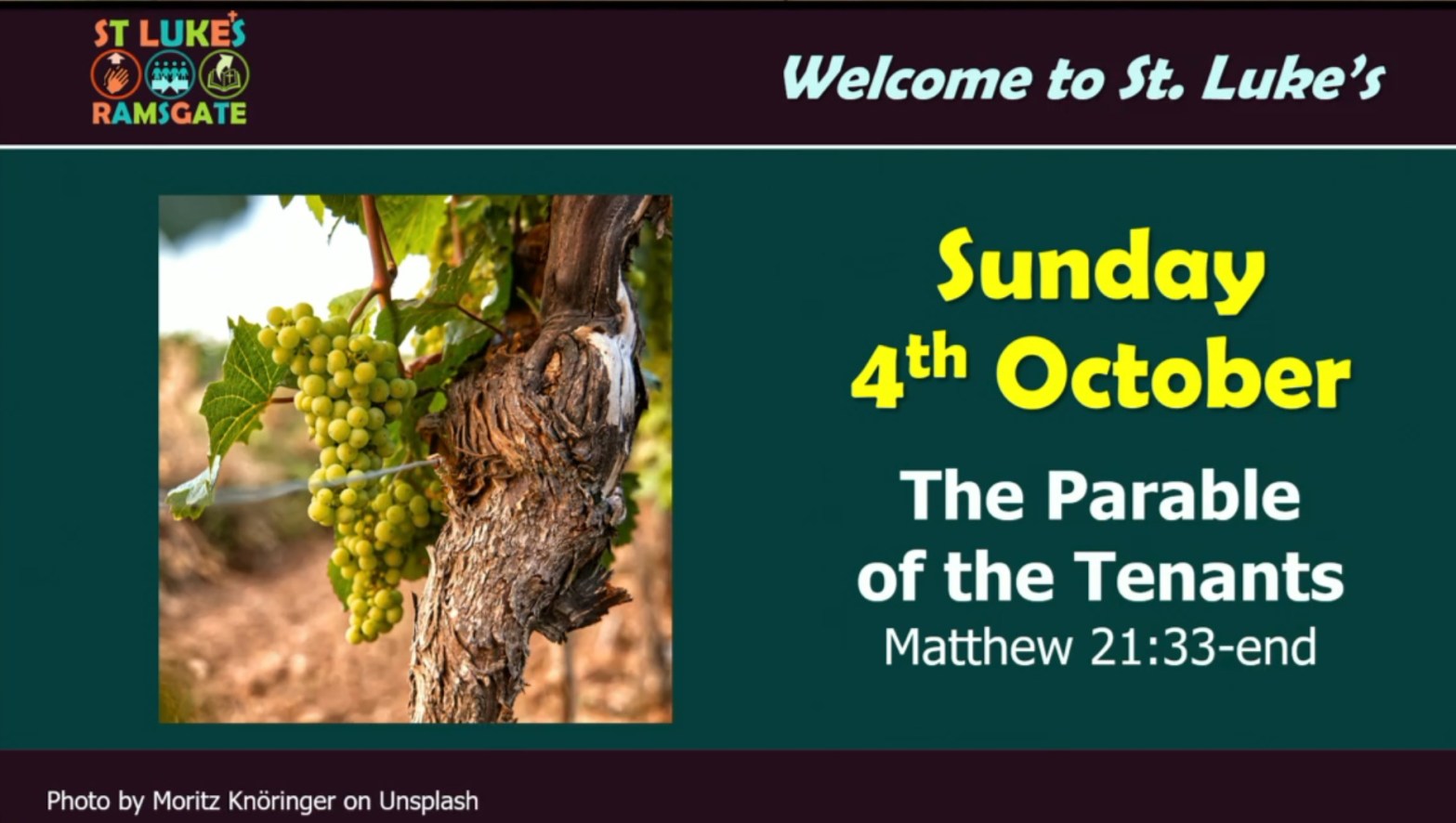
The Parable of the Tenants (Matthew 21:33-46)
Who tells you what is right or wrong in life?
When St. Luke’s was opened as a church 150 years ago, a significant part of the population would have said, that the church was there to show them what was right or wrong. Others would have pointed to favourite philosophers and their books, whilst I suspect many would have said their parents. Still others, may well have simply said, “No-one tells me what to do!”
Today, those answers are still relevant to many, but for others the main sources for the knowledge of right and wrong are very different. There is the internet, social media and most recently Artificial Intelligence. For many, these are now their source for advice on everything including what is right or wrong.
But, given all these increasing choices, how do we decide who to listen to?
Jesus in the Temple
The Parable we have had read to us comes as part of Jesus’ debate with the temple authorities, the Chief Priests and elders.
The day before Jesus told the parable he had entered into Jerusalem on a donkey, with the crowds crying out,
“‘Hosanna, to the Son of David, blessed is he who comes in the name of the Lord!” (Matthew 21:9)
Everyone knew that this was a claim to be the Messiah, the Christ, the one descended from King David, whom God had promised would come and set up a new kingdom in his name, a new authority on earth. It was a bold and radical claim to authority.
But the challenge did not stop there. As soon as he arrived in Jerusalem, Jesus had gone straight to the temple and cleared out the money changers and the salesman declaring:
“It is written,” he said to them, “`My house will be called a house of prayer,’but you are making it a `den of robbers’.” (Matthew 21:13)
In other words, rather than the Temple being focussed on helping people come to and follow God, it had become an exercise in making money. This was a perversion of what God wanted. The temple authorities were allowing it to happen and Jesus was telling them this was wrong.
So, when Jesus came again to the temple the next day, the Chief Priests and elders of the people came to him and asked,
“By what authority are you doing these things? And Who gave you this authority?” (Matthew 21:23)
In other words, “What right have you to tell us what is right or wrong?”
You might think that was a good question. Who was this upstart rebel from out in the sticks to tell the duly appointed authorities in the temple what they should be doing? Notice, however, that they don’t defend their actions or explain why Jesus was wrong to accuse them. No, they seek to undermine Jesus’ authority instead.
Jesus’ response is to ask them about John the Baptist:
“John’s baptism, where did it come from? Was it from heaven or human origin?” (Matthew 21:25)
It’s not a question they can answer, because they had never taken John seriously, whilst many of the crowds that were watching this debate had believed John to be a Prophet, a spokesperson for God.
So, Jesus starts telling Parables. The first parable is all about obedience. There are two sons, one who says he won’t do what his father says, but then does it, whilst the other says he will do what his father says, but then does not do it. Jesus is clear, with the temple authorities. They are like the second son. Their position and status suggests they are all about doing what God wants, but the reality is that they are not at all interested in living in God’s way. They might try and deflect Jesus’ criticism of them by questioning his authority, but the more fundamental issue is that they are not interested in obeying God at all.
The Parable of the Tenants
Then, Jesus tells another parable. It is perhaps the most shocking of all the parables. It gives a shocking insight into what is really going on in the hearts of the religious leaders of his day, and their refusal to do what God wants, but also answers the question about Jesus’ authority.
In the story, Jesus tells, a man builds a vineyard. In other words he puts lots of money, time and effort to create something that will take years to pay off. Then, as was common in those days he rents it out to tenants on the understanding that since he has provided them with the means of making a living, they will pay him a proportion of the crop as rent.
In the story, Jesus tells, however, the tenants refuse to pay their rent. They have no interest in doing what was right by the landowner or sticking to their agreement. So, the owner sends his servants to demand they pay up. But rather than doing what they are told, they beat up or kill the servants. In a show of amazing patience, the vineyard owner keeps sending servants with the same result. Then he ups the stakes. He sends his son. Surely, the son will be seen as coming with the landowner’s authority, they will listen to him and do what he says.
But the landowner is wrong. In a shocking turn of events, the tenants decide to kill the son, rather than listen to him and do what he asks. They were prepared to go to extreme lengths to avoid doing what the landowner rightly required.
Jesus then asks, what the owner of the vineyard would do. The Chief Priests and elders, would have identified with the vineyard owner, because they were mostly of the landowning class. So, they feel the anger at the tenants behaviour and give a clear answer as to what will happen:
“He will bring those wretches to a wretched end and he will rent the vineyard to other tenants, who will give him his share of the crop at harvest time.” (Matthew 21:41)
Of course, Jesus is catching them out. As they came to realise, the Parable was directed at them. In the parable, the vineyard owner represents not one of them, but God. They are represented by the tenants. They owed their positions, their lives and everything they had to God. But, by refusing to do what God wants, they like the tenants were refusing to give him what they should.
So, what about the other characters in the story? The servants refer to the prophets whom God sent to tell the people to change their ways and to follow him, but over the centuries, those prophets had been ill-treated and sometimes murdered for speaking God’s word. The most recent example of which was of course, John the Baptist!
So, who was the Son? Jesus of course sees himself as the Son. In the parable he is predicting the shocking events that were about to take place. Rather than accept his authority as God’s ultimate representative to show them what is right and wrong and to obey what he says, they were going to have him killed. And within a few days this is what happened. Instead of listening to Jesus, they crucified him. In so doing, their true hearts were revealed and they showed themselves and their institution worthy of God’s judgement.
Within 40 years, the Temple in Jerusalem, that looked like it was built to last forever, was totally destroyed by the Romans. The wretched leaders of the temple were brought to a wretched end. You can only carry on rejecting God’s voice and warnings for so long.
The Rejected Stone and the New Temple
Jesus, however, adds an addendum to the Parable. He quotes from Psalm 118:
“The stone the builders rejected has become the cornerstone the Lord has done this, and it is marvellous in our eyes’?” (Matthew 21:42; Psalm 118:22,23)
Jesus knows that the temple authorities, were going to reject him in the most brutal and shocking way possible. They were going to crucify him.
But, he also knew that their rejection was not the end. God would raise him again from the dead and he would become the capstone for a new temple. Not made of dead stones, but living stones. Not a building misused for purposes counter to God’s will, but a community of people saved from past sins, and now living to do what God wants, because they have accepted that Jesus is indeed God’s son and they have chosen to listen to his words and do what God wants with their lives.
Who tells you what is right or wrong in life?
So, who tells you what is right or wrong in life?
The world is changing rapidly, and the number of voices vying to tell us how we should live is growing. They may be old fashioned sources, like religions, philosophers and books or up to date ones like Google or Artificial Intelligence. But before we ask the question who to listen to, we need to ask a deeper question.
Do we recognise who it is that has provided us with the world we live in and the life we have? Do we accept that there is a creator God, who made us and provides for us and has a right to demand that we live in certain ways? For many this is the biggest barrier.
What is shocking about the tenants in the story Jesus tells, is that they are quite happy to reap the blessings of the vineyard built by someone else, without being willing to accept that they should offer anything to him for the privilege. If that is our attitude, then the question of authority does not matter. We will either choose to follow any voice or authority that appeals to us at the moment or just drift along with the crowd. However, this is the root to futile thinking, foolish hearts and darkness.
However, secondly, when we accept that God should have a say in our lives, then we will want to ask the question that Jesus asks about John the Baptist:
“Is their message from heaven, or of human origin.”
When we look at the philosophers of the world, the many books written, the advice from friends and relatives, Google or even Artificial Intelligence, they are all ultimately sources of advice that have a human origin.
But, in the Parable, the vineyard owner, who represents God, sends many servants. These represented the prophets of Israel over the years. Their message is written down in what we call the Old Testament. They are worth listening to. But, Jesus makes a more radical claim in the Parable. He says, that he is not just a servant of God, He is the Son of God. His authority and teaching is of a whole higher level.
It is a claim shown to be true, by what happens next. Jesus proves that he is the stone the builders rejected, that becomes the capstone. In other words, the cross and resurrection is Jesus’ ultimate answer to the question about his authority. Those historic events certify his claim that he is the Son of God and show that we should live life in obedience to his teaching. To follow him is to truly grasp hold of the life that God offers.
Have you accepted that Jesus is God’s Son? Will you allow him to direct your life as to what is right and wrong? Or will you make the same mistake as the Chief Priests and elders of Jesus’ day?

