“Know therefore that the LORD your God is God; he is the faithful God, keeping his covenant of love to a thousand generations of those who love him and keep his commands.” (Deuteronomy 7:9)
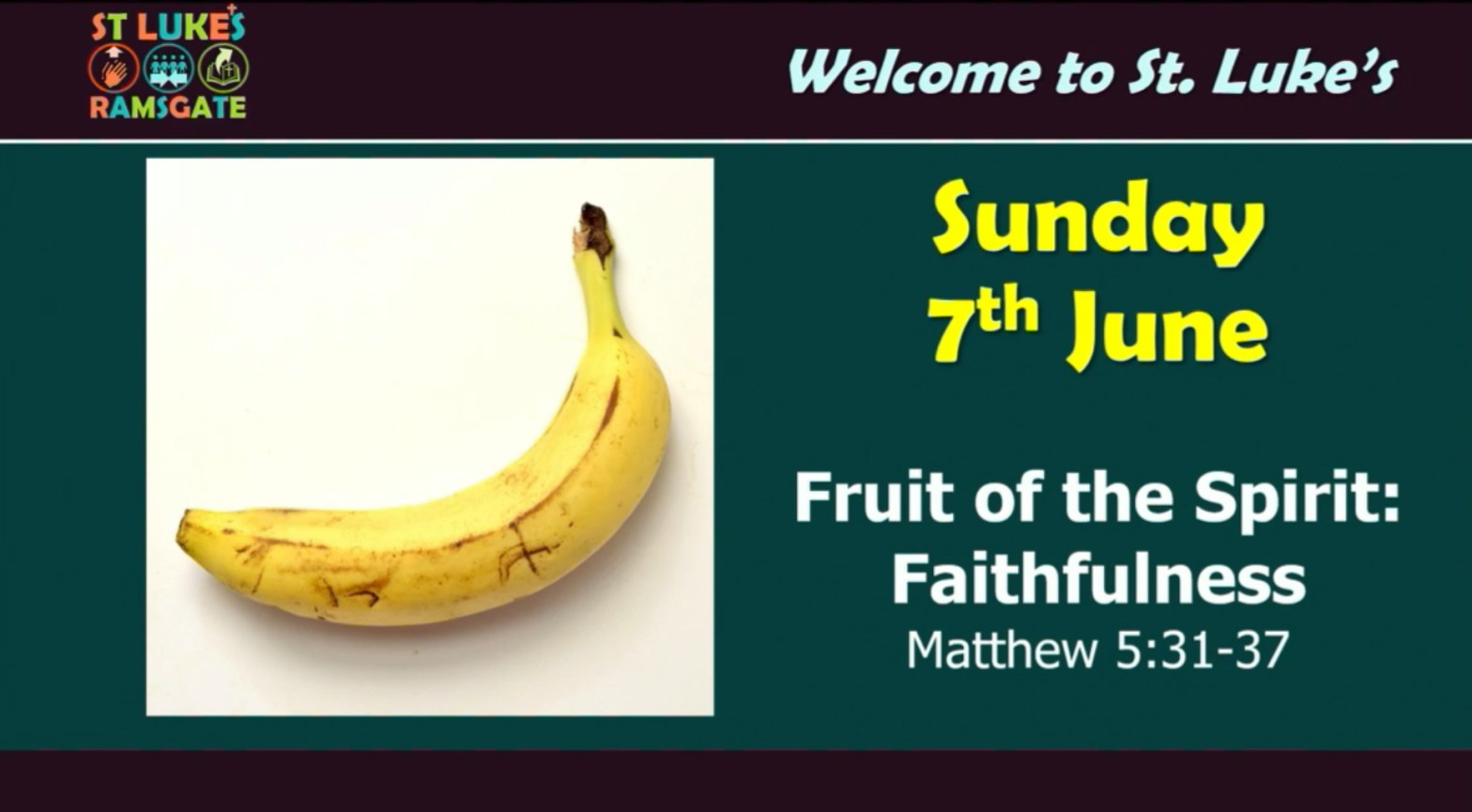
This Sunday we return to our series on the Fruit of the Spirit, this week focussing on the characteristic of faithfulness.
Fruit of the Spirit: Faithfulness (Matthew 5:32-37)
What does faithfulness look like?
Michael Hyatt an American leadership guru tells of an experience early in his career. He was given the job of marketing director at one of the larger publishing houses in the US, even though he didn’t have any experience.
So, his boss put him on an informal three-month probationary period, so that if it didn’t work out, they could give up on the experiment and Michael would leave and look for another job, but if things went well, he would be kept on and given a 10% pay rise.
Michael worked and studied hard to succeed at the job and things went really well. When it came to the end of the probationary period, he was actually looking forward to the end of probation review.
His boss started off by commending him for doing so well and told him he was really impressed with how hard he had worked and how well he had done. Then he told him there was a problem. The company had instituted a wage freeze. They wouldn’t pay him the extra 10% that had been promised on the completion of a successful probationary period.
Michael felt deeply disappointed. But then something amazing happened.
His boss handed him an envelope. In the envelope was a cheque for the extra 10% that had been promised, which his boss had decided to pay out of his own money. The boss felt he had made a commitment to Michael and he needed to live up to it, even though it cost him.
This is an amazing example of what it means to be faithful. To stick to your promises, even when it costs you or hurts you to do so.
Faithfulness the 7th Characteristic of the Fruit of the Spirit
We are going through a series on the Fruit of the Spirit. In Galatians, Paul lists nine characteristics of the fruit of the Spirit, characteristics that we learn as Christians when we learn to keep in step with the Spirits, the kind of characteristics that reflect the very character of God.
We have already looked at six of the characteristics in two bouts of three. Now we are starting on the last three. So, this week, it is the seventh characteristic, which is faithfulness.
Faith is at the heart of what it is to be a Christian. The key Christian message is that we are saved when we put our faith in Jesus Christ.
But faith and faithfulness are two-sides of the same coin. You have faith in someone because they are faithful. You can trust someone when they are trustworthy. You depend on someone when you think they are reliable. As Christians, we have faith in the God of Jesus Christ, because we believe he is faithful.
God is Faithful
The New Testament is clear that we can trust God, that he is faithful.
Because God is faithful, we can be confident that we are protected and secure:
“But the Lord is faithful, and he will strengthen and protect you from the evil one.” (2 Thessalonians 3:3)
Because God is faithful, we can have hope:
“Let us hold unswervingly to the hope we profess, for he who promised is faithful.” (Hebrews 10:23)
Because God is faithful, we can know that our sins are forgiven:
“If we confess our sins, he is faithful and just and will forgive us our sins and purify us from all unrighteousness.” (1 John 1:9)
Indeed, the whole Biblical narrative is set up to show God’s faithfulness. At its most basic, the plot of the Bible is that God makes promises and God proves faithful to the promises, despite the unfaithfulness of his people.
God promised Abraham that he would become a great nation. The first half of the Old Testament, shows bit by bit, how God fulfilled that promise until, by the time of David, Abraham’s descendants were indeed, a great nation.
Then God promises, David, that there would always be one of his descendants on the throne. This remained true in Jerusalem for hundreds of years. But in the end Jerusalem became incorporated into the great empires of the time.
Yet, the prophets said, God’s promise to David was not forgotten, a Messiah would come to sit on his throne.
Then comes Jesus, who is both the descendant of David, who rules on a far greater and eternal throne at God’s right hand not as king in Jerusalem, but as king of the universe and who truly blesses all nations, by dying for the whole world and sending his followers to share the good news with all nations.
As Paul says in 2 Corinthians:
“For no matter how many promises God has made, they are “Yes” in Christ.” (2 Corinthians 1:20)
The whole story of the Bible points to the faithfulness of God.
And if faithfulness is a key characteristic of God, then as those who have His Holy Spirit within us, it will be a key characteristic for us as well.
Our Faithfulness:
So, what will our faithfulness look like? It will mean that we are honest and reliable.
Honest with the Truth
First of all to be faithful means to be honest. It means people should be able to trust what we say as speaking the truth.
Honest speaking is so important. It is impossible to make a good decision unless people tell the truth.
Take a court of law. If the witnesses do not speak the truth, then justice will not be done and either the guilty will go free or the innocent will be condemned.
So, for us as Christians, we need to be people who can be trusted to speak the truth. We need to be trusted to speak the truth about what God says. Paul says to Timothy,
“and what you have heard from me through many witnesses entrust to faithful people who will be able to teach others as well.” (2 Timothy 2:2)
In preaching or teaching the Christian message, whether in conversations with friends in the workplace, at home with the family or from the front of church, we need to speak God’s word faithfully. That takes courage. The temptation is always to speak in a way, so as to please those who are listening to us, rather than to be honest about the truth. To be a faithful messenger of Christ means being willing to say the hard truths when they need to be heard.
Honest with Promises
It also requires being honest with what you promise. In our reading from the Sermon on the Mount, Jesus challenges the people of his day about the practice of adding special ‘oaths to what they say’.
But he says you should not need to make an oath:
“Rather, let your ‘Yes’ be ‘Yes’ and your ‘No’ be ‘No’. Anything more is from the Evil One.” (Matthew 5:37)
In other words, we should be faithful in everything we say, not just when we are made to swear a special oath. He is not saying we should not swear an oath when we are required to do so, as in a court of law, but that we should treat all that we say in the same way. All of it needs to be faithful and true.
This requires wisdom and courage. We need to be careful about what we promise. It can be easy to promise to do something, because you do not want to disappoint someone, but we should be willing to say we cannot commit, or to explicitly say, I won’t promise anything, but I’ll do my best, rather than commit to something we know we will not be able to do.
It is better not to make rash promises, than to make a promise you do not want to keep. Because being faithful also means being reliable, not just saying what you will do, but doing what you say.
Reliable
Reliability is an aspect of faithfulness, that means we keep our promises, but we also carry out the duties entrusted to us.
In talking about our role as Christians, Jesus compares himself with a master who entrusts his servants with resources whilst he goes away. Those servants who do what is expected he commends:
“His master replied, `Well done, good and faithful servant! You have been faithful with a few things; I will put you in charge of many things. Come and share your master’s happiness!'” (Matthew 25:21)
Jesus expects us to be reliable in carrying out our duties as Christians in this life.
In the same way, we should be reliable in keeping our promises. That is not always easy. At times to keep your promises means making sacrifices. If you have promised one friend to be at their party, but then another friend invites you to a more exciting party, then the cost of keeping your promise is missing out on the better party.
If you have agreed to accept an offer on a house, but then a better offer comes along, then the cost of keeping your promise, is to lose out on the money you might have had on the better offer.
As we saw in the example in the introduction, being faithful can at times mean having to make sacrifices.
So, being faithful means sticking with your promises, but also carrying out the duties entrusted to us as volunteers, employees or even in marriage.
Marital Faithfulness
Marriage is of course a relationship based on promises. The vows made at a wedding ceremony are important promises and at times they can be hard to keep.
In Jesus, day, many people were quoting the verse from Deuteronomy:
“Anyone who divorces his wife must give her a certificate of divorce.” (Deuteronomy 24:1)
and claimed that a man could divorce his wife whenever he became fed up with her.
But Jesus is clear that although there may be serious reasons that require divorce, like your husband or wife having an affair, God’s plan for marriage is for it to be a permanent union. Later in Matthew he says,
“What God has joined together, let no one separate.” (Matthew 19:6)
So, to be reliable in marriage will take sacrifice. It will mean putting up with the times when you find each other annoying, it will mean sticking by an ill husband or wife and coping when they are made redundant and the money is tight. This can feel like sacrifice, but it is worth keeping with it.
It can also mean saying, ‘No!’ to the potential affair with the more attractive or charming person who offers themselves to you. This too can feel like a sacrifice, but it is worth keeping with it.
And to be faithful in marriage means more than just sticking with it, it means working at it, being faithful to the role that has been entrusted to you to love, cherish and care for your husband or wife.
Sadly, many marriages do fail. You can be the perfect husband or wife, but if your partner is unfaithful or bails on the marriage, you can still find yourself divorced. Even if you know that your marriage failed partly or even wholly because of you, Jesus is also clear that his forgiveness covers all sins. We should never want divorce, but if it comes, we can still turn to the one who is ultimately faithful and true, Jesus Christ.
Faithfulness is a key characteristic for marriage. But I think all the characteristics of the fruit of the Spirit will help to create a flourishing marriage. The more you can both grow in the characteristics of love, joy, peace, patience, kindness, goodness, faithfulness, gentleness and self-control, the more your marriage will be amazing.
The Man on the White Horse
Faithfulness is a hard characteristic to put into practice, whether in marriage or life more generally. At times it takes courage and sacrifice. But when we do, we will find that our relationships with others flourish. The more they see we can be trusted, the more they will trust us. That will mean we have a greater opportunity to share the good news about the one who is ultimately faithful.
Remember that with all the characteristics of the fruit of the Spirit, Jesus is our model.
At the end of the Bible, there is a vision of Jesus leading the forces of heaven to their ultimate victory over evil:
“I saw heaven standing open and there before me was a white horse, whose rider is called Faithful and True.” (Revelation 19:11)
 St. Luke's Church Ramsgate