“The Son is the image of the invisible God, the firstborn over all creation.” (Colossians 1:15)
The readings from Joshua 10:1-14 and Matthew 15:21-28 describe pivotal moments in the stories of the Old Testament and the New Testament respectively, moments which are of great consequence for us in how we understand what God is doing in the world today.
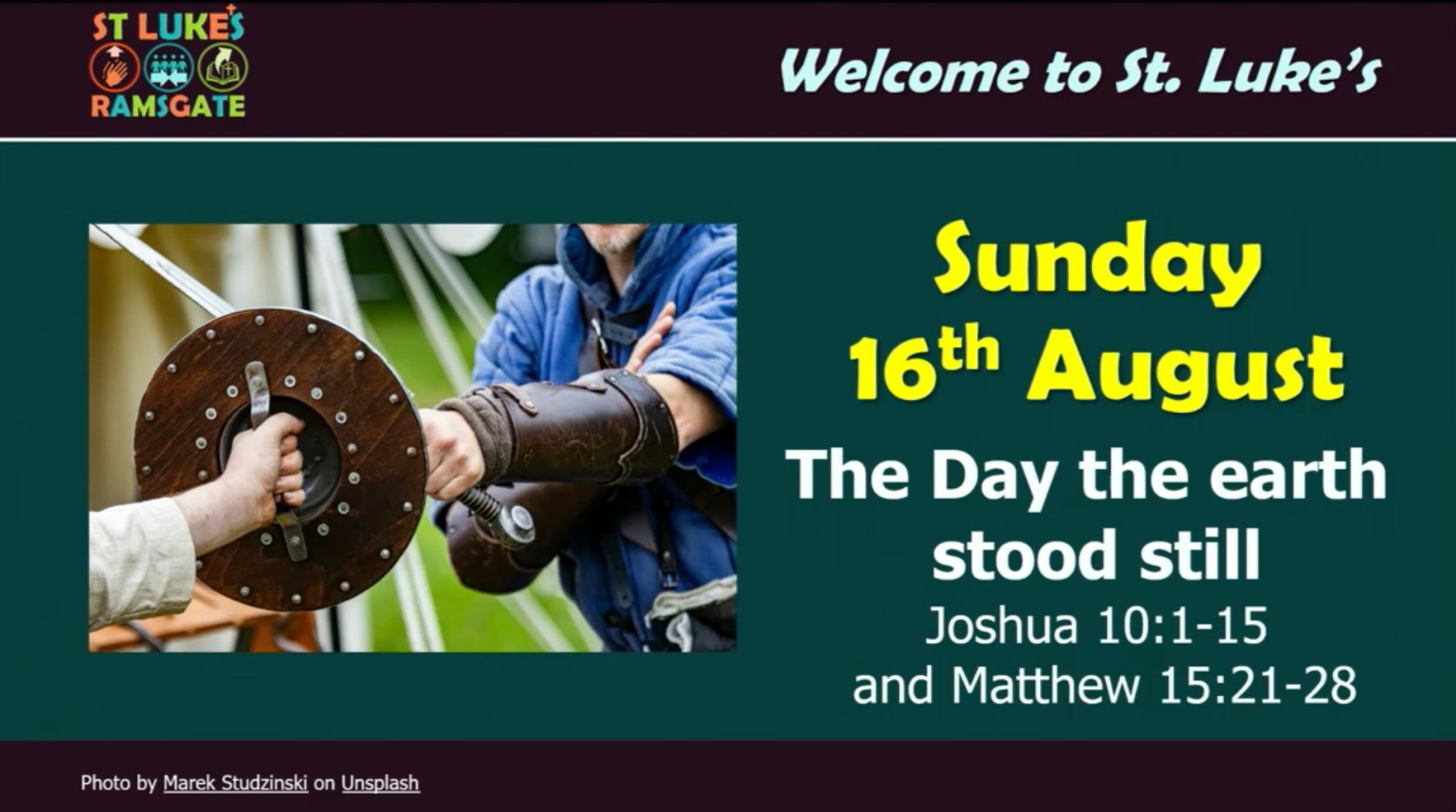
The Day the Earth Stood Still
The readings we have just heard from Joshua chapter 10 and the Gospel of Matthew chapter 15 describe pivotal moments in the stories of the Old Testament and the New Testament respectively, moments which are of great consequence for us in how we understand what God is doing in the world today.
The best way I have of explaining what is happening in those chapters is to start not with them, however, but with the Hollywood movie, The Day the Earth Stood Still. I’m talking here not about the 2008 remake, but the original film of 1951. In it, an alien spacecraft lands in Washington, and the people of Earth are warned that their new-found capacity to wage and to threaten nuclear war has brought them to the attention of the other inhabitants of the galaxy. Klaatu, the alien protagonist, at first has trouble gathering the presidents and prime ministers of the world together to hear what he has to say, so he captures their attention by making the Earth stand still.
Not literally, of course, in the sense of preventing the Earth from rotating on its axis. The Earth rotates at a speed of over 1,000 miles per hour at the Equator, and if it were possible for it to stop rotating, even for a moment, disaster would straightaway follow. Everything that was not bolted down, including the water contained in all the seas and oceans, and every living thing on Earth would be flung out into space at a tremendous speed, where they would instantly perish. Klaatu doesn’t precipitate this kind of destruction. Instead, in a demonstration of his otherworldly power, he brings everything that is mechanically or electronically powered to a complete halt – cars, radios, TV sets, escalators, elevators, etc. – for one hour. To prevent loss of life, the only things permitted to carry on are aeroplanes in flight and electricity in hospitals. That is how the Earth stood still in the film: not literally, but metaphorically.
To add to this, there is another layer of meaning to the title of the movie, a second time when the Earth metaphorically stands still. That is at the very end of the film when Klaatu, having gathered the leaders of the world together, delivers an ultimatum to them: step back, and stay away, from the brink of nuclear conflict, or else face destruction at the hands of a universe that will not tolerate this kind of risk. There follows a pregnant pause, while leaders from all around the world absorb this threat, and everyone waits for them to respond. And then the credits start rolling for the end of the film. The Earth metaphorically stood still while waiting for the answer to this cliff-hanger, and in this sense, it has stood still ever since.
So now we come to the story of the Old Testament, as seen through the lens of Joshua chapter 10. In this chapter, the Israelites engage in a war, not of aggression, but of defence in aid of the Gibeonites, with whom they have entered into a military alliance. On the morning of his conflict with the Amorite kings, Joshua had prayed for the sun and the moon to remain in the sky simultaneously, as an aid for him in battle. So this was the Day the Sun Stood Still.
Please note, it could not have been the case that the sun literally stood still, because the sun does not revolve around the Earth. So we as readers have to find some other way of understanding what happened on this day. Some have understood the metaphor as indicating that the Earth was indeed prevented from rotating on its axis for twenty-four hours, so that it looked as though the sun had stopped in the sky. The problem with this reading has already been mentioned: it would have involved the immediate and fatal propulsion of every living thing on Earth into space, at break-neck speed.
Others have understood what happened in a completely different way, a way which is informed by the astrological superstitions that formed part of the non-Israelite, ancient near Eastern worldview.
According to this worldview, the shifting position of the stars in the sky acted as omens for what was likely to take place on the ground on any one day. The best day to go to war was widely agreed to be a day, that came in at around the middle of each month, but could not be predicted accurately to the exact date, on which the sun dropped below the horizon only a matter of a couple of minutes after the moon had risen, so that there was hardly any time at all when the sun and the moon both appeared in the sky at the same time . According to this astrological superstition, the days immediately before and afterwards, on which the sun appeared to be in no hurry to set, but stayed visible on the horizon long after the moon had risen, were thought to be extremely bad days on which to conduct warfare.
On this reading of Joshua chapter 10, and especially of verses 12 and 13, Joshua was praying for the day of battle to be one on which his enemies would see in the sky what they considered to be a bad omen, and start the day discouraged and frightened as a result. And so it turned out to be on the day of battle: the sun didn’t hurry to go down – as it did on a good omen day – until the following day, by which time the battle had been won and lost. ‘There has never been a day like it before or since’, commented the writer of the book of Joshua in chapter 10, verse 14, not because something had happened that was astronomically unthinkable, but because it was a day ‘when the LORD listened to a man’ who prayed as Joshua did, and granted his request.
And on this reading, the Day the Sun Stood Still was also the Day the Earth Stood Still, waiting to see what would happen in the wake of the battle Israel had entered. Remember that this was a defensive war, prompted by the attack the Amorites made on the Gibeonites, with whom the Israelites had allied themselves. But back in Deuteronomy chapter 7, we read the command to Israel that ‘when the LORD your God brings you into the land you are entering to possess and drives out before you many nations … you must destroy them totally. Make no treaty with them, and show them no mercy … [or] the LORD’s anger will burn against you and will quickly destroy you.’ So the question at issue in Joshua chapter 10 is really whether the Israelites’ defence of the Gibeonites would lead to their own destruction.
This is a pivotal moment in the Old Testament, when we begin to learn how God chooses to work in the world today. And what we learn in this chapter is that, in a first and momentous step, the LORD extends his mercy past the ethnic boundaries of the people of Israel to embrace the Gibeonite people. This is the first step in helping us understand that his mercy extends to all who fear him, from generation to generation.
And if we can agree that this is a momentous step – a step on a journey which, if never taken, would have left all of us without God and without hope in the world – then let us [move on to the next slide and] think now about the second step, which is in our Gospel reading, Matthew chapter 15, verses 21-28.
The Canaanite woman from Tyre and Sidon was a descendant of the people who were defeated in battle with the Israelites, and so was her demon-afflicted daughter. The mother had no basis for any claim on the attention and compassion of Jesus, but she goes ahead and stakes a claim anyway, in the simplest of terms: ‘Lord, Son of David, have mercy on me’. Initially, he refuses to answer her, saying to his disciples that he was ‘sent only to the lost sheep of Israel’ (Matthew 15:24).
I think we can see what is at stake here. ‘Is the Davidic Messiah’s role to be that of a new Joshua who … will lead an obedient Israel in driving out the Canaanites who survived the original conquest, repossessing and cleansing the land? Or is his role confined to that of the shepherd of God’s scattered and injured sheep, healing and gathering them, saved at last from oppressive leaders and threatening nations alike?’1 What is Jesus’ final answer in relation to those outside the promise made to Abraham going to be?
It is as if the whole earth was standing still at that moment, with everyone waiting with bated breath to find out what answer he would lock in. Whichever way it goes, it won’t just be this Canaanite woman and her daughter who’ll be affected. All non-Jewish people in every generation, everyone including you and me, have skin in this game.
In answer to the Canaanite woman’s repeated cry for help, Jesus replied that ‘it is not right to take the children’s bread and toss it to their dogs’ (Matthew 15:26). ‘Yes, Lord’, she responded, in great humility and with great insight, ‘but even the dogs eat the crumbs that fall from their master’s table’ (Matthew 15:27).
The story concludes with a momentous decision on the part of Jesus in favour of extending mercy far past the boundaries of Israel. This is a red-letter day for understanding how God works in the world. It is actually the fulfilment of the promise made to Abraham that the nations of the earth would not be destroyed, but would be blessed through him.
And, in fact, this decision had already been made:
- in the eternal purpose of God, to bring all nations within his kingdom;
- in Matthew’s Gospel narrative, which begins with a genealogy that includes Tamar, Rahab, Ruth and Bathsheba, and a nativity narrative which includes the Magi;
- and by Jesus himself, who said back in Matthew chapter 8 that many would come from the east and the west, and would take their places at the feat with Abraham, Isaac, and Jacob in the kingdom of heaven.
What we have read in Matthew chapter 15 is simply the story of the day salvation came to the house of the Canaanite woman. And so the story of God’s favour reverberates throughout the pages of the entire New Testament, just as it does through the Old. Because of God’s favour, the Day the Earth Stood Still became the day the crumbs fell from the Lord’s table, for us to scoop up. As I hope you already know, none of us here are worthy to gather up the crumbs under his table, but he is the same Lord, whose nature is always to have mercy. We rejoice daily in this mercy; we cling daily to this mercy. In this way, there are no longer any barriers to our communion with God. It is granted to us so to eat the flesh of his Son Jesus Christ, and to drink his blood, that our sinful bodies may be made clean by his body, and our souls washed through his most precious blood, that we may evermore dwell in him, and he in us. So let us cling to his mercy, and rejoice in his mercy, for Jesus’ sake.
1 Richard Bauckham, Gospel Women, p. 44.

