“…[let us not give] up meeting together, as some are in the habit of doing, but [let us encourage] one another – and all the more as you see the day approaching.” – (Hebrews 10:25)
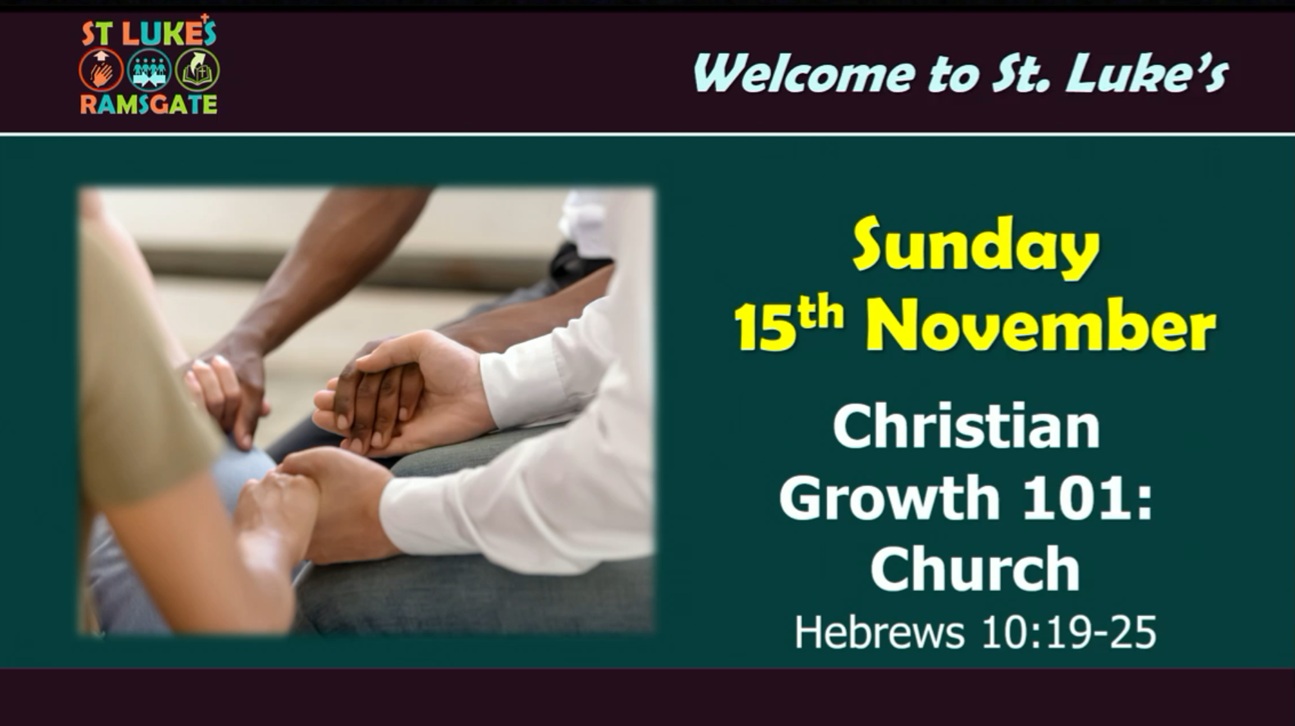
This Sunday we continue our mini-series on Christian growth and look at the importance of meeting together as a church.
Christian Growth 101: Church (Hebrews 10:19-25)
Giving up on church?
In the last verse of our reading it says,
“…not giving up meeting together – as some are in the habit of doing…” (Heb. 10:24)
The writer to the Hebrews is addressing a problem. People are giving up on attending church, they are not meeting up with other Christians, like they used to. This was a problem in the first century, and it is a problem in the twenty-first century?
It is hard to be sure why people give up attending church today, although we might suggest a number of reasons:
- we live in a culture that is increasingly individualised and isolated. Technology encourages us to stay at home and be entertained or communicate remotely, rather than gather with others.
- we live increasingly busy lives, with jobs that often push us to work on Sundays or demand so much time that we have limited time to spend with our families, and there are so many other options for our time on Sundays, whether it be shopping, sports clubs or other activities.
- we live in a society that sees itself as secular and deprioritises the Spiritual or the secular.
All of these are pressures at work on people to stop them attending church. In the first century, there were different pressures. For Jews in particular, there were pressures to give up on Christianity or downplay Christian faith, because it was easier to be a Jew, which was a protected faith in the Roman Empire, than a Christian that was treated with suspicion by the Roman authorities and other Jews.
Yet, the writer of Hebrew’s response is to remind people of the significance and importance of Jesus. He is not just another religious leader or someone introducing a new style of Jewish faith, or interesting new teachings. He was the Son of God, the one who made the once and for all sacrifice to deal with our sins and so break open a new and living way to God, that was not available before and is not available by any other means.
What stops us de-prioritising our faith? Being reminded that Jesus offers us the only real hope that we can have as Christians. This is what the writer to Hebrews has done in the first part of his book and verses 19-21 summarise all of that.
The House of God – vs. 21
And the conclusion is this Jesus is ‘the great high priest over the house of God.’ Here, ‘the house of God’ does not refer to a physical building. There was a physical temple in Jerusalem, and Jesus was not made High Priest of that temple. No, the house of God, refers to the people of God, those who belong to him, those who believe in his Son.
We do not relate to Jesus simply as individuals, but as part of this household. To be a Christian is to belong to the church. We may rightly emphasise that each individual Christian needs a personal relationship with Jesus, but we must also emphasise that to come to Jesus, is to become a part of the family of Jesus.
So, as our passage moves from reminding us what we have in Jesus, it goes on to call for a response, but not as individuals, but as a community. Three times, it says, ‘let us…’. It is in community that we grow as Christians, supported and encouraged by one another.
So, let us look at those three responses that are called for, and see what they show us about the church.
Belong by Faith: A Hospital for Sinners – vs. 22
The first call is to:
“let us draw near to God with a sincere heart and with the full assurance that faith brings, having our hearts sprinkled to cleanse us from a guilty conscience and having our bodies washed with pure water.” (Hebrews 10:22)
This is an incredibly rich verse and we have not the time to delve into all its richness. But notice, that we come to God through faith. The faith being talked about here is faith in Jesus as God’s great High Priest, who has made the once and for all sacrifice for our sins.
Church is not a place for perfect people to gather. It is a hospital for sinners. In the gospels, Jesus says, “It is not the healthy who need a doctor, but the sick. I have not come to call the righteous, but sinners.” (Mark 2:17)
When a vicar is licensed to a new parish, their role is described as ‘the cure of souls…’. But, it is not really the vicar’s role. It is Jesus who cures souls, the vicar, is just there to point people to the one who gives salvation. And it not solely the vicar’s role. It is the role of the whole church, to remind each other that we are all sinners, but that we can be cleansed from a guilty conscience through Jesus’ once and for all death.
Our modern world, is increasingly quick to condemn others and try and justify our own actions. Neither activity is humble, allowing us to accept our own wrongdoing and seek help. Neither activity cleanses a guilty conscience. Neither brings true healing to the soul.
Only through gathering with other Christians focussed on faith in Christ and his once and for all sacrifice for our sins, do we find real healing. That is why when we meet we confess our sins and remember Jesus death on the cross through Holy Communion. It is not meaningless ceremony or words, but a way to regularly remind one another of the heart of our faith.
Together in Hope: A Light for the World – vs. 23
The second call is:
“let us hold unswervingly to the hope we profess, for he who promised is faithful.” (Hebrews 10:23)
In the Old Testament, Moses led the people out of Israel with a vision of hope. Hope for a world free from the oppression of their Egyptian slave masters and hope of a better country, which God would provide. They left Egypt together in hope.
Jesus’ however, offers us an even greater hope than Moses. As it says of the great heroes of faith in Hebrews 11:
“…they were longing for a better country – a heavenly one. Therefore, God is not ashamed to be called their God, for he has prepared a city for them.” (Hebrews 11:16)
As those who believe in the resurrected Christ, we have taken hold of a hope that the world cannot offer, a hope that overcomes death, a hope of a better life beyond death.
So we are to come together and remind each other of that hope. That together, as a community of hope, we can be a beacon of hope to the world. After all, Jesus said to his disciples:
“You are the light of the world…” (Matthew 5:14)
And the truth is that we shine brighter, when we are lit by regular meetings with other Christians. If coals in a fire are kept together, they will continue to grow. When one coal is lifted out of the fire and put on the side, it quickly stops glowing. We need to surround ourselves with people of hope, that we might truly be able to offer hope to the world around.
Meeting for Love: Encouraging one another – vs 24-25
The third call is longer, but it begins:
“Let us spur one another on towards love and good deeds…” (Hebrews 10:24)
As a church we are called together to have faith in Jesus’ historic once and for all sacrifice, to have a confident future hope in Jesus, and to encourage one another towards love and good deeds in the present.
It is only as we meet with the family of Christ, that we can be shaped to live increasingly like Christ. Paul says in 1 Corinthians:
“Follow my example, as I follow the example of Christ.” (1 Corinthians 11:1)
In the past, people have told me that this makes Paul sound arrogant. But actually, we should all be ambitious to do the same thing, because this is how we encourage growth in the church.
The reality is that most of our behaviour is learnt through imitating the behaviour of others that we trust and respect. If we want new Christians to become more Christ like, then those of us who are long standing members of the church should be examples to them, so that in becoming part of our community they have lots of examples to imitate that will encourage them towards love and good deeds.
This of course goes alongside good teaching. Paul says in Ephesians:
“Instead, speaking the truth in love, we will grow to become in every respect the mature body of him who is the Head, that is, Christ.” (Ephesians 4:15)
It is as we pray, care and share the word with one another, that the church is built up. But, we need to do it with one another.
But, we need to do it with one another. We need to be part of a church.
Don’t stop meeting…
I remember when I first went to live in London after university to start my teacher training. I had been a strong Christian for most of my life, but now I was living by myself in a strange new city. I had to make the effort to try out a new church in this new stage of life.
It would have been very easy not to have done so. Before this point, I had been taken to church by my mum or encouraged to go along with a group of Christian friends. For the first time I had to make my own way. It felt hard, it felt difficult. The temptation was not to bother. But with God’s help I attended a nearby church. I was welcomed, and quickly encouraged to be a part of one of their small groups.
During that year of teacher training and on my teaching practices, I made friends, but had no real strong Christian connections. It was the support of that small group and the encouragement of the wider church that sustained me through what was perhaps the most fragile stage of my Christian journey.
Can I encourage you to make meeting with other Christians a priority? Make joining others at church on a Sunday morning a priority and if you are not already part of one of our life groups, why not consider joining one. For most people, it is only really through such small groups, that we can be encouraged by others and offer encouragement to others.
If you have come to know Christ as the only way to God, how can you not prioritise meeting with his people?

