“He will judge between many peoples and will settle disputes for strong nations far and wide. They will beat their swords into ploughshares and their spears into pruning hooks. Nation will not take up sword against nation nor will they train for war anymore.” – (Micah 4:3)
How much better if there was no possibility of war? People would not die needlessly, economies would not be damaged and increased resources could be put into improving our world. That is a dream that has existed for centuries and is expressed so powerfully by Isaiah in the verse above. Jesus says, ‘Blessed are the peacemakers.’ Let’s do our bit to pray and work for peace.
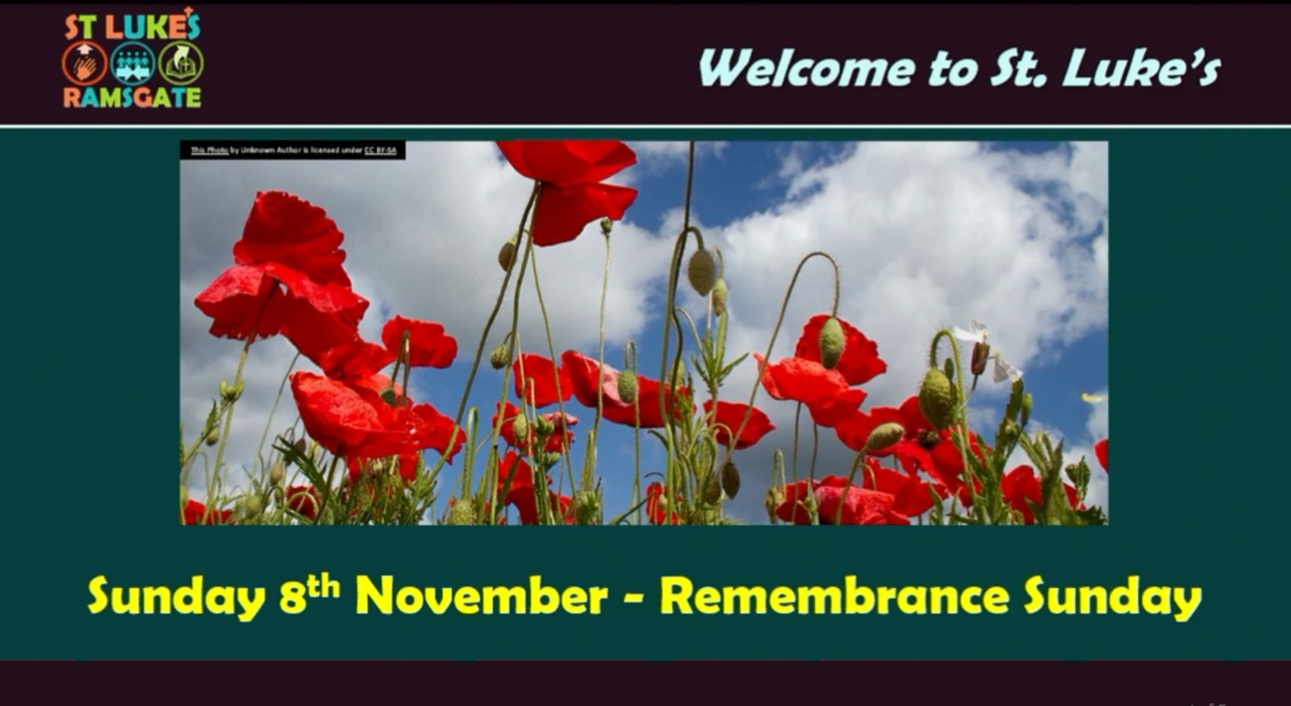
Remembrance Sunday (Micah 4:1-5)
Remembrance is a sacred duty. Victoria Roshchyna was a prizewinning Ukrainian journalist reporting on the Russian invasion of her country. In the summer of 2023, she wanted to visit Russian-occupied eastern Ukraine to report on the situation there, but of course there was no safe way of getting through the front lines of conflict, so she travelled via Poland and Russia, with a view to entering Ukraine from the east. She let her family know that she had made it through the border controls, and then she disappeared. That was the last time they heard from her. Eight months later, the Russians confirmed that she was being held in detention, and six months after that, they reported that she had died, and returned her body to her family. The Russians said that she died of heart failure; her friends and supporters said that she was tortured and strangled. It was impossible for Ukrainian doctors to assign a cause of death, because, horrifically, the Russians had removed from her body the eyes, the brain, and the larynx. In so doing they had delivered a “savagely unsubtle” warning – do not see the Russian action, do not think about it, do not talk about it.[1]
Today, we have a sacred duty to see what has happened and is happening in the world around us, and to think about it, and to speak about it. But at the same time we also have a duty to pay attention and to draw attention to the word of the LORD that has come to us through the prophet Micah. In Micah chapter 4 verses 1 to 5, the prophet speaks about four things, one after the other, and we will follow his thread, starting with the fact that on this Remembrance Sunday, the prophet calls us to remembrance and reflection.
From what Micah says, we can tell that he had experience or memory, of war, or at any rate that he was familiar with a history of war. Embedded within the prophecy that nations will beat their swords into ploughshares, and their spears into pruning hooks, is the memory of a time when nations did arm themselves to the teeth with the technologies of death – and when have nations ever failed to do this? Contained within the notion that one day armies would no longer train for war is the realistic observation that at the time the prophet wrote, and in all the time since right up until today, preparing for war is all that armies ever do.
These facts call for solemn remembrance, and deep reflection. Tragically, in the two thousand and seven hundred intervening years since Micah’s prophecy, the human race has added a great deal to its experience, memory, and history of war. Yet some things seem never to change. Despite one hundred years of Remembrance Sundays and prayers for peace, some things seem never to change. War continues to put the engine of technology into overdrive. Conflict is no longer prosecuted with swords and spears. The demands of warfare have led to the composition of gunpowder, the invention of the machine gun, the splitting of the atom, and much else besides. Remember, and reflect. A month or so ago, I was listening to a radio programme about the rapid development and new applications of drone technology. It was clear from the radio programme that all the funding behind this research and development is geared towards military, not civilian, applications. What does it say about human nature, that so much creativity and commitment has been poured into, and continues to be poured into, the technology of war?
We would do well, also, to reflect on the exercises that are part and parcel of military training. Athletes train for competition; apprentices train for trades; job candidates train for interview; actors rehearse for performances. It must be so frustrating for members of the armed forces to participate in combat exercises in preparation for circumstances that no-one ever wishes to see come to pass. It must be frustrating for security and political personnel on the COBRA committee to repeatedly war-game responses to nightmare threats they hope will never materialise. In fact, I can only think of one thing worse than training for a conflict which never arrives. That is to train for a conflict, which does arrive, in all its deadly horror. We remember and reflect.
And we do this, of course, in common with our neighbours, of other faiths and of no faith. This morning’s Bible reading, however calls us to much more than remembrance. Because of our Bible reading, as well as this being Remembrance Sunday, for us it is also Anticipation Sunday. “In the last days … Many nations will come and say ‘Come, let us go up to the mountain of the LORD, to the house of the God of Jacob. He will teach us his ways, so that we may walk in his paths’” (Micah 4:1,2). People will seek to come into the presence of God and under his jurisdiction. The Jerusalem temple was of course the locus of God’s presence in Old Testament times, and in the New Testament we learn that when Jesus speaks of the temple being destroyed, and raised again in three days, the temple he speaks of is his body (cf. John 2:19-22), because he is, in his own self, the locus of God’s presence on earth. This is the staggering claim which lies at the heart of the Christian message. This is the great mystery of faith: Christ has died, Christ is risen, Christ will come again. And the signs of his coming kingdom will be that the nations will beat their swords into ploughshares, and will not train for war anymore. We will know that peace has finally come, not simply when the fighting stops, but when all the weapons of war have been decommissioned, and all the armies have been disbanded. And we will know when peace has come when, in the words of Micah chapter 4, verse 4, ‘everyone will sit under their own vine and his under their own fig tree, and no one will make them afraid, for the LORD Almighty has spoken.’ This image of a safe and beautiful garden dwelling place is used by Micah and several other Old Testament prophets, and it makes the last days sound like a restoration of the first days of human innocence, as depicted in the first chapters of the book of Genesis.
It is clear, I think, that this description is a long way from our present reality. The Protestant Reformer, John Calvin, once commented that “we might indeed do without the sword, [if we] were angels in this world” – but, as we are not, “the use of the sword will therefore continue, to the end of the world”.[2] We ought not be surprised at the wars which rage, and which have been raging, over a hundred years of Remembrance Sunday, and more besides. Yet neither ought we be dismayed, give up praying for peace as a lost cause, or lose the prophetic anticipation that one day true peace will come. We know that what is impossible with man is possible with God. As far as lost causes go, Christian faith itself is faith, after all, in the resurrection of the dead. We may not give up on that hope, and we need not give up on it, because Christ’s resurrection is the guarantee of ours. Of course, these last days are not yet ours to see, but we hear about them from the prophet Micah. And so, as much as it is our duty today to recollect and reflect on the sacrifice and horror of war, it is also our holy duty to think, to speak, and to joyfully anticipate war and all wrongdoing being, in the mercy of God and under the lordship of Christ, being finally brought to an end. This is the true audacity of hope.
To remember and to anticipate is not the end of our duty this day. Directly after learning that swords will be beaten into ploughshares, and that everyone will dwell in safety and harmony with nature, we read in Micah chapter 4 verse 5 that “All the nations may walk in the name of their gods”. This is a prompt for us to recognise that on top of Remembrance and Anticipation Sunday, this is also Clear-Sighted Sunday, on which we must see things exactly as they are, in the cold light of day, and not through rose-tinted glasses. This statement that “all the nations may walk in the name of their gods” may seem a jarring reality check in the light of what has gone before. Remember that “in the last days the mountain of the LORD’s temple will be established as chief among the mountains; it will be raised above the hills, and peoples will stream to it” in Micah 4 verse 1. In the following verses, they willingly come under the LORD’s instruction and protection. And then in verse 5, we’re back to a situation in which “the nations may walk in the name of their gods”. However, there is no real contradiction here. The difference is one of chronology. It is the difference between what will take place in the last days, for which we need holy anticipation, and what is the present reality now, for which we need the clearest of clear sight: “the nations walk in the name of their gods”; that is what they do.
In the ancient Near East, every nation had its god, and every god had its nation. All of them boasted that they were the greatest, and disputes about this were commonly settled on the field of battle. So now let us think for a moment about the modern equivalent of ancient polytheism and idolatry. When I was younger, there was a popular Christian paperback written by an author named Richard Foster which tried to identify the gods of the present age. The name of the book was Money, Sex, and Power. More recently, and more insightfully, I think, someone named Michael Lockwood, in a book called The Unholy Trinity, has proposed a much more basic triad of idolatry: me, myself, and I. “Idolatry is everyone’s problem”, Lockwood writes, and he explains himself like this: “God plays too big a part in human life for us to be able to abandon him without attempting to fill the resultant void with something [else] … The human heart must necessarily have something to love, and something to believe and trust in. The one thing we cannot do is live with a spiritual vacuum. Therefore idolatry is not optional. We may not [all] think of ourselves as religious, but if we refuse to fear, love, and trust the true God in any part of our lives, we are compelled to construct some idol to take his place.”[3]
In Micah chapter four, verse 5, the fact that “the nations may walk in the name of their gods” seems to be offered as an explanation for the persistence of war: for all the time they continue to do so, nation will keep rising up against nation. Idolatry, in the sense of the worship of ‘me, myself, and I’, is an equally good explanation of rivalries and disputes on a local, inter-personal level. “What causes fights and quarrels among you?”, asks the apostle James in the fourth chapter of his letter. “Don’t they come from your desires that battle within you? You want something but don’t get it. You kill and covet, but you cannot have what you want. You quarrel and fight. You do not have, because you do not ask God. When you ask, you do not receive, because you ask with wrong motives, that you may spend what you get on your pleasures” (James 4:1-3).
Whether on a macro-level, or on a micro-level, the Scriptures of the Old and New Testaments hold up an unflattering mirror to the human race. There is no dewy-eyed sentimentality to be found here about human nature and potential. The Bible’s clear-sightedness extends to the possibility of a diabolical reversal of Micah’s prophecy of swords being beaten into ploughshares, and spears into pruning hooks. The prophet Joel speaks of ploughshares being beaten into swords, and pruning hooks into spears (Joel 3:10). The scholars of Scripture have noted that the Hebrew prophets’ description of the LORD’s end-time rule “is not [any] part of a human social program … Rather, the holy city, New Jerusalem, descends out of heaven from God”.[4] So our remembrance and our anticipation on this day is joined with a realism about the way things are in the world, and in our own lives, right now.
And this clear-sighted realism is to be accompanied by one last thing, which is also to be found in Micah chapter four, verse 5. “All the nations may walk in the name of their gods … [but] we will walk in the name of the LORD our God for ever and ever”. So it’s not only Clear-Sighted Sunday, it is also Determination Sunday: “we will walk in the name of the LORD our God”.
I am a big fan of the Michael Apted ‘7 Up’ series, in which a group of fourteen children, first interviewed for World in Action in 1964 at the age of seven, were subsequently interviewed at seven-year intervals throughout their lives, most recently this year for the program ’70 Up’. I will never forget the interviewer critically probing the Christian values of one of the participants in the light of the societal, attitudinal changes taking place all around him, either at age 35 or 49, I don’t remember which. “Where does our changing society leave your values?”, was the interviewer’s challenge, to which the interviewee bluntly replied, “It leaves them with me, and with my family”. What he said about his values, Christians may say about the Lord they follow. The Gospel of John records a time when many of the disciples of Jesus “turned back, and no longer followed him”, prompting him to ask the Twelve, “You do not want to leave too, do you?”, to which Peter replied, “To whom [else] shall we go? You have the words of eternal life” (John 6:66-68). In these words we find a determination to walk in the name of the LORD for ever. This was a determination that faltered dramatically for Peter after Jesus was arrested – to be sure, it did falter. But, by the grace of God, and thanks to the prayers of Jesus himself, it was a determination that did not fail in the end.
On Remembrance Sunday, on Anticipation Sunday, on Clear-Sighted Sunday, on Determination Sunday, we have a sacred duty. It is to see, and think, and speak in response to what has happened, and is happening, in the world around us, as did Victoria Roshchyna, the Ukrainian journalist. But it is also to receive and to pass on the word of the LORD: to remember and reflect; to see things as they really are, but also to nurture the audacity of hope for what the world and we ourselves will be; and to determine to cling to him, who himself holds us fast in everlasting love. Amen.
[1] Julian Evans, ‘A dark fairy tale’, Times Literary Supplement, no 6415, October 2, 2026, page 12.
[2] John Calvin, Jonah, Micah, and Nahum, p. 266.
[3] Michael Lockwood, The Unholy Trinity, page 32.
[4] Childs, Isaiah, p. 31.

