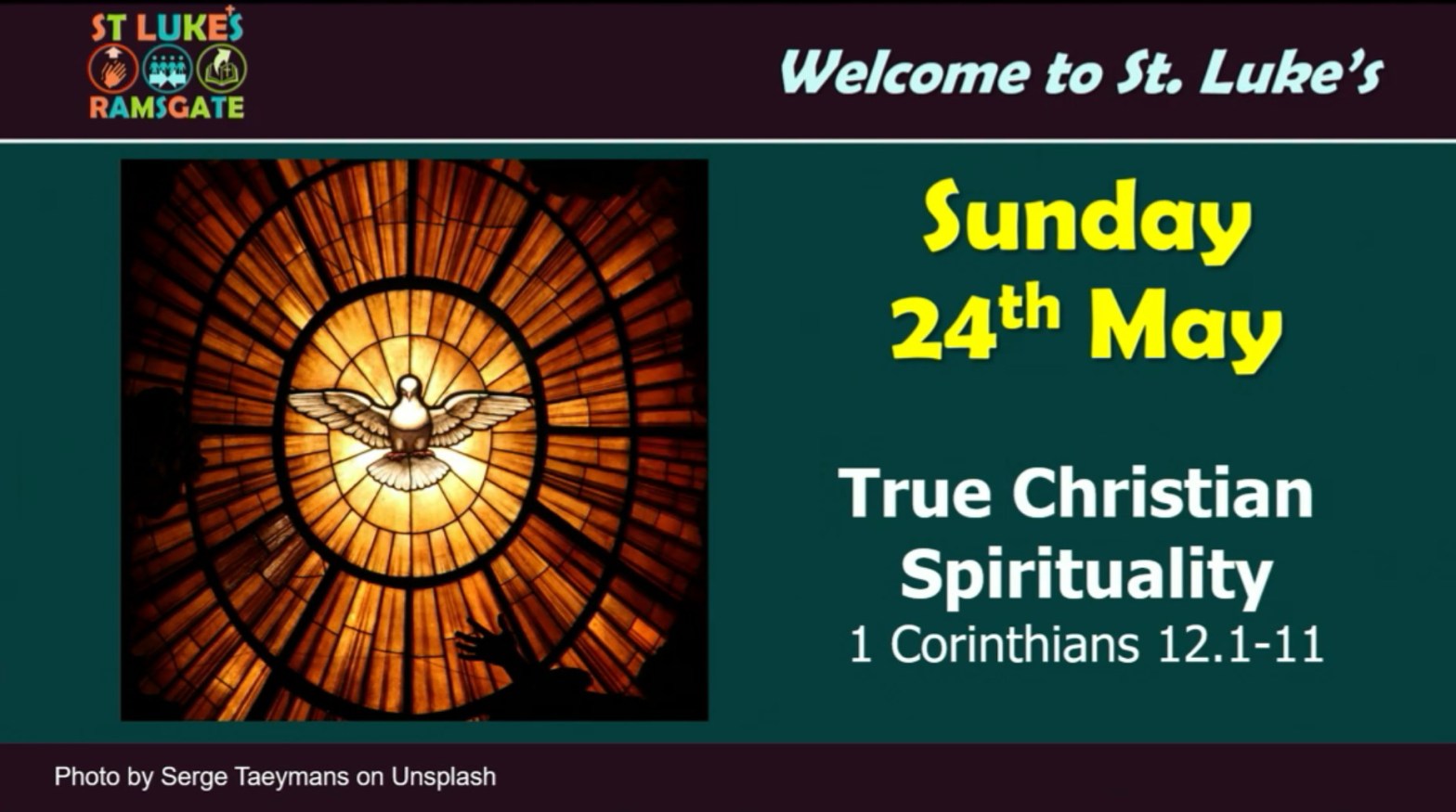
“Now to each one the manifestation of the Spirit is given for the common good.” (1 Corinthians 12:7)
This Sunday is Pentecost. It is the day we remember God sending his Holy Spirit onto the church. The events of the day itself were spectacular and memorable with the sound of a rushing wind, flames of fire settling on the disciple’s heads, the apostles praising God in different languages that visitors to Jerusalem could understand and, perhaps most amazingly, 3,000 people becoming Christians and being baptised!
True Christian Spirituality (1 Corinthians 12:1-11)
Recently I watched a couple of episodes of a TV programme that follows a group of celebrities of various faiths and none as they embark on a walking pilgrimage and speak to camera about the effect the experience is having on them. Among the group there is only one Anglican, who turns out to be non-practising and who, in the first episode, was surprised to learn that anyone at all believed in the existence of Jesus Christ, having previously considered him to be fictional. In the second episode, he asks his fellow pilgrims the following question: ‘What would you call a hybrid of, kind of, just people of faith, who are spiritual, who aren’t in a particular lane?’ meaning, a particular faith tradition. ‘Why would you need to pick a lane?’ he asked. ‘Why can’t you just appreciate all of it?’
Watching this programme made me wonder: If only there were reliable apostolic teaching to guide this questioner, and all who ask similar questions, about the nature of true Christian spirituality!
And recently I came across an Anglican source of information recommending a wide range of spiritual practices to students, including: going on a pilgrimage; learning about mosses or lichens; spending 15 minutes every day watching slugs or snails in their natural habitat; adopting the habit of talking to strangers in public places; getting a tattoo; attending yoga or breathing-based meditation classes; and so on.
And reading this resource made me wonder: If only there were reliable apostolic teaching to guide students, and all who seek such guidance, about the nature of true Christian spirituality!
The good news is that there is apostolic teaching about the nature of true Christian spirituality, and it is reliable precisely because of Pentecost. The stunning account of the coming of the Holy Spirit is the reading that is most commonly chosen for church services on Pentecost Sunday. Today, however, our reading concerns the stunning effect of the work of the Holy Spirit in the life of the church.
1 Corinthians chapter 12 begins with these words of the apostle Paul: ‘Now about spiritual gifts, brothers, I do not want you to be ignorant’. Except that it doesn’t begin like this, not quite. If it were spiritual gifts the apostle wanted his readers to know about in the first instance, he would have used the Greek word ‘charismata’ to describe them here in his opening line. But he doesn’t. Instead he uses the term ‘pneumatikos’, which when translated from Greek into English means either spiritual people, spiritual things, spiritual matters, or spiritual stuff. Many English translations of the Bible insert the word ‘gifts’ into this sentence, but there is no textual basis for doing so. A much better translation of verse 1 would be ‘Now about spirituality, I do not want you to be ignorant’.
And this is good news, because many of us, inside and outside the church, are in need of reliable apostolic teaching, not first of all about spiritual gifts, of what they consist, as important as that issue is. First and foremost, it is more important for us to know about true Christian spirituality, of what it consists. And this is exactly what we find in 1 Corinthians chapter 12. More precisely, in this chapter we are told at least four things about Christian spirituality – four things we ought to take to heart, if we haven’t already done so, or four things we need constant reminders of, even if we think they’re obvious, in case we ever forget, or are tempted to take them for granted.
And the first thing of four is this: true Christian spirituality is Jesus-centred. It begins and ends with the affirmation that Jesus is Lord. It’s there in 1 Corinthians 12, verse 3. If you come across a spirituality which does not put the lordship of Jesus Christ front and centre, then there is nothing specifically Christian about that spirituality. And our non-practising Anglican celebrity friend from the television is correct in one respect. Other spiritualities are available: spiritualities centred on the human body, on the human spirit, or on human potential; spiritualities based on the natural world, or on any number of assembled deities. The Corinthians knew this, and the apostle Paul writing to them knew this. At one time, Paul writes in verse 2, the Corinthians were pagans, influenced and led astray to mute idols, given over to ecstatic utterances, it may have been. What was the content of those utterances, Paul wanted to know? Did they confess the Lordship of Christ, or did they anathematise him?
This is the point at which we have to choose a lane. By affirming one thing, we inevitably reject its alternatives. If we think of ourselves as spiritual, but do not inhabit any particular faith, we are not in a position to appreciate any of them. Faith is only as good as its object. Indeed, it is nothing without an object. Christians do not put their faith, in faith. They dare not put their trust not in themselves, or the created order, nor in any other thing except the person of Jesus Christ, the Lord of heaven and earth. That is the identifying mark and beating heart of true Christian spirituality.
You would think that there would be agreement on this within the church, and yet there is a version of Christianity that, in the words of the social activist and blogger Jon Kuhrt, “has had its rough edges nicely rounded off, to ensure that it does not cause offence”; that foregrounds “the charity, the inclusion, and the community action” associated with Christian faith, “without reflecting the passion and fire that has driven the motivation to establish most of the significant Christian initiatives”. In his blog, Jon Kuhrt mentions the habitual saying of his father-in-law that “when you speak about Christianity, you’ve got to mention the J-word”, and he tells the story of when he shared this saying with a fellow Christian campaigner, who replied ‘You’re so right, justice is so important!’1
It turns out that all of us need constant reminders of the J-word, which many people use only as an expletive, lest we forget or downplay the centrality of the lordship of Christ to true Christian spirituality. The highest pinnacle of spirituality, as far as the apostle Paul is concerned, the greatest work of the Holy Spirit and the plainest evidence of his work is not an ecstatic spiritual gift. It is when people confess that Jesus Christ is Lord, to the glory of God the Father.
True Christian spirituality is also Spirit-enabled, as we learn from 1 Corinthians chapter 12, verse 3: ‘No-one can say ‘Jesus is Lord’ except by the Holy Spirit.’
When parcels are delivered, they are sent from the warehouse to customers via a delivery fulfilment centre, changing hands several times, and the final, most complex step in the logistical chain is the ‘last mile’ from the local hub to safe arrival in the hands of the intended recipient. The Holy Spirit is he who enables this ‘last mile’ from the Jesus of history to the Christ of faith formed in the hearts of believers.
At times, it seems as though the Spirit is the forgotten third person of the Holy Trinity, and yet his work in us, convicting us of sin and righteousness and judgement, as Jesus himself puts it (cf. John 16:8), this work completes and perfects the saving action of the Trinity towards humankind. ‘The Father sent the Son to be the Saviour of the world’ (1 John 4:14), but without the work of the Spirit creating and sustaining faith in us, it might all have been for nothing. But in point of fact, ‘if anyone acknowledges that Jesus is the Son of God,’ it is because God the Holy Spirit ‘lives in him and he in us’ (1 John 4:15). Thank God that the work of the Holy Trinity is not for nothing!
Whenever Christians have begun to lose sight of the work of the Holy Spirit, they have robbed themselves of the comfort of God’s embrace, and are at risk of being trapped within a paradigm of inadequate effort and uncertain reward in search of God’s favour. I don’t know when the rot started, but it certainly wasn’t in the days of the Protestant Reformation , when Martin Luther explained the phrase ‘I believe in the Holy Spirit’ in the following way:
‘I believe that by my own understanding or strength I cannot believe in Jesus Christ or come to him, but instead the Holy Spirit has called me through the gospel, enlightened me with his gifts, made me holy, and kept me in the true faith, just as he calls, gathers, enlightens, and makes holy the whole Christian church on earth and keeps it with Jesus Christ in the one common, true faith. Daily in this Christian church the Holy Spirit abundantly forgives all sins – mine and those of all believers. On the last day the Holy Spirit will raise me and all the dead and will give to me and all believers in Christ eternal life.’2
I suppose that, if we are being honest, the rot is at risk of starting every day, so conditioned are we to the language of merit and attainment, and so reluctant are we to acknowledge that we do not actually deserve the love poured out on us by God. This means that we require a fresh work of Pentecost to take place within us each new day, to sustain us in trusting and total reliance on his mercy.
True Christian spirituality is also community-minded. It is not the spirituality of self-actualisation, self-fulfilment, or self-absorption. It is very much like the opposite of those things. The apostle Paul evidently thought that this was a message that the Corinthians needed to hear. ‘There are different kinds of gifts, but the same Spirit,’ he writes in chapter 12, from verse 4 onward. ‘There are different kinds of service, but the same Lord. There are different kinds of working, but the same God works all of them in all. Now to each one the manifestation of the Spirit is given for the common good’.
A Bible scholar named Colin Kruse has pointed out what I suppose is obvious to anyone capable of reading between the lines here: “Several passages in 1 Corinthians 12 suggest that there were disintegratingforces at work in the Christian community at Corinth”, he writes. “On the one hand, there were those who weremade to feel inferior because they did not exercise the same spiritual gifts as others and thought they were unworthy to be regarded as members of the church, while on the other hand, there were those who became so inflated through the exercise of gifts given to them that they felt no need of other members of the church”3
Those who felt superior, did so because they were thinking of themselves, rather than others, and taking pride in themselves. Those who felt inferior, did so because they were thinking of themselves, not others, and despairing of themselves. Despair and pride: these are the forces of disintegration that can divide and conquer any congregation. God save us all from such self-absorption here at St Luke’s! God keep us humble of heart and considerate of others here at St Luke’s, in mutual service and genuine love.
Whatever gifts we have, the apostle Paul tells us, put them to work for the common good, and not for the sake of your own self-esteem. The community needs these gifts to function and flourish, to be sure, because we each have something unique to bring to the table, and we should not hesitate to bring it. But our egos ought not be bound up with the exercise and recognition of our gifts. The heart of true Christian spirituality is expressed in the prayer of Richard Alleine, which was taken up by John Wesley: ‘I am no longer my own, but yours. Put me to what you will, rank me with whoever you will. Put me to action, put me to suffering. Let me be employed for you, or laid aside for you, exalted for you or brought low for you. Let me be full, let me be empty. Let me have all things, let me have nothing. And now, O glorious and blessed God – Father, Son, and Holy Spirit – you are mine, and I am yours’.
True Christian spirituality is marked not only by selflessness towards God in prayer, like this prayer of Alleine and Wesley, but also by selflessness towards others in community. It does not entail an interior mystic journey of the soul in the ecstasy of solitude, and the glorious privilege of non-contradiction. Instead, it involves the embodied, real-world experience of everyday life, together with others, and the demands they place upon us.
So true Christian spirituality is Jesus-centred, Spirit-enabled, and community-minded. Last but not least, true Christian spirituality is freely given, rather than being achieved. ‘To one is given through the Spirit the message of wisdom,’ we are told in 1 Corinthians 12, verse 8, ‘to another the message of knowledge by means of the same Spirit, to another gifts of healing by that one Spirit’, and so on and so forth down to speaking in different kinds of tongues, and the interpretation of tongues (1 Corinthians 12:8-10). ‘All these are the work of one and the same Spirit’, writes the apostle Paul in verse 11, ‘and he gives them to each one, just as he determines’. Whatever he does is in his gift, and it is altogether his free gift.
Most gifts are not like this, are they? Every year there is a Christmas dinner and a secret Santa gift exchange at the office in which I work. A month or so before the dinner, my colleagues and I agree on a spending limit and circulate details of items within that threshold we would welcome as gifts. On the evening of the dinner, we exchange cards, unwrap our parcels and usually find within them something that was on our wanted lists. I do something similar to this for Christmas with members of my immediate family, and I would not be surprised to learn that you do too. These kind of arrangements are reciprocal. At their best, they are motivated by appreciation, friendship, and love, rather than obligation. For the most part, I hope, they are well received, though it is worth mentioning that there is a risk-reward calculation involved in the occasional purchase and giving of something that did not appear on any list. Generally speaking, these exchanges conform to a clearly understood pattern, and there is nothing wrong with that. Even so, it may be observed, without criticism, that they are not entirely free practices. They operate within well-established social conventions.
The Holy Spirit, by contrast, is completely free. He gives gifts ‘just as he determines’ to those who have had no opportunity to specify their preferences, and who are in no position to reciprocate. I think that this is incredibly liberating. When it comes to the practice of spirituality, I believe we are prone to being uptight and stressed out. That is why there are TV programmes about people searching for a sense of the sacred, and that is why there are self-help style resources for spirituality involving as often as not an enchantment with nature or a deep dive into one’s own psyche. The apostle Paul’s message of liberation is that we don’t have the responsibility to find or to make sense of ourselves, because God himself, in the person of the Holy Spirit and in his freedom, has loved us, sought us out and found us.
There is absolutely no space for Christians to be smug about any of this. Those in the church are just as prone as anyone else to be anxious and stressed out about spirituality in general, and spiritual gifts in particular. But if the Holy Spirit gives gifts for the common good, and just as he determines, then that lifts true Christian spirituality out of the realm of human achievement and performance anxiety altogether. We may speak in this way as a direct consequence of the saving work of God the Holy Spirit at Pentecost, travelling the ‘final mile’ to reside within our hearts, renew our faith, and inspire our hope. We may pray for this to be the daily reality of our lives, and – because this is his work, not ours – we may be thankful, and live lives of gratitude and pure joy.
1 https://gracetruth.blog/2011/06/25/mentioning-the-j-word-andy-hawthorne-at-the-national-prayer-breakfast/
2 From Martin Luther’s Shorter Catechism, in R. Kolb and T.J. Wengert, The Book of Concord (Fortress Press, 2000), pp. 355-356.
3 Colin Kruse, New Testament Models for Ministry (Thomas Nelson, 1983), p. 116.

