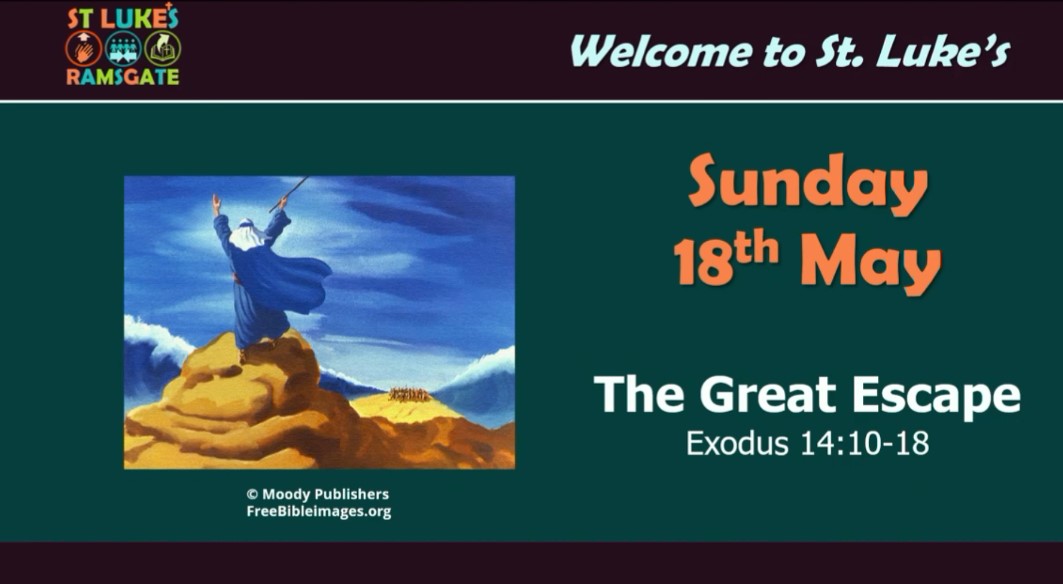
Exodus 14:13a: “Moses answered the people, ‘Do not be afraid. Stand firm and you will see the deliverance the LORD will bring you today.”
This week we look at the victory God gives to the Israelites, when they are trapped between the advancing Egyptian army and the Red Sea.
The Great Escape (Exodus 14:10-18)
Last year the National Archives in London put on an exhibition called ‘Great Escapes: Remarkable Second World War Captives’. The experience of Dunkirk and the Channel crossings of the Little Ships that are being commemorated over the next couple of weeks in Ramsgate weren’t included in this exhibition. Instead the exhibition featured the stories of prisoners in German prison camps who plotted daring escapes, including the mass escape from Stalag Luft 3 that was made the subject of the film titled ‘The Great Escape’, as well as stories of those who simply managed to survive in captivity. According to the National Archives, this offered ‘glimpses of the courage and ingenuity that is possible in desperately hard times’ and explored the indefatigability of the ‘human spirit’.1
I suppose ‘The Great Escape’ wouldn’t be exactly the right title for an exhibition that did include the story of Dunkirk and the little ships, because no matter how courageous, resourceful and indefatigable the soldiers beaten back to the beaches of northern France were, they wouldn’t have been able to actually swim the English Channel to escape the German onslaught. They could not have escaped unaided. When we hear that phrase, ‘The Great Escape’, I suppose we think naturally of courage, and ingenuity, and the human spirit. Let’s be honest, we probably also think specifically about British courage, resilience, and the English stiff upper lip. That is why we hear the title track to ‘The Great Escape’ film at international football matches, with the England chant right at the end.
And so, when we heard that Bible reading just now, from Exodus chapter 14, I think we’d be right to question whether ‘The Great Escape’ is really the most appropriate title for the sermon today. In fact, there’s not a lot in the Bible, considered as a whole, as far as celebrating courage, ingenuity, and the human spirit is concerned. That would be the message of optimistic humanism, that would be the message of positive thinking, that would be the message of nationalistic chauvinism, even, but it isn’t really the message of Christianity. And in this passage in particular, there’s nothing really to be found in terms of the indefatigable human spirit. Like the troops at Dunkirk, the Israelites were on the run, and were still vulnerable to attack from a fearful enemy. But they were not courageous or resilient, and they did not possess stiff upper lips. Instead, they were terrified, traumatised, and loose-lipped. Rather than effecting a Great Escape, they seem to have suffered from a Great Depression.
I say that the people of Israel were terrified, because in chapter 14, verse 10, it says this in so many words; ‘they were terrified’.
I say they were traumatised because the trigger for their terror, according to verse 10, was that they ‘looked up, and there were the Egyptians, marching after them’. In order to understand this, we have to lay aside the visions Cecil B. DeMille has put in our heads of finely-dressed and glamorous-looking Egyptians, not a scary sight at all, and imagine instead what it must be like to see the approach of a powerful force which is able to kill you, and is determined to kill you.
I say the Israelites were loose-lipped because of what they are reported to have said to Moses in verses 11 and 12 of chapter 14:’Was it because there were no graves in Egypt that you brought us to the desert to die? What have you done to us by bringing us out of Egypt? … It would have been better for us to serve the Egyptians than to die in the desert!’ Here we are a long way from the derring-do of a Great Escape. Terror, trauma, and talk born of this terror and trauma, combine together to make instead a Great Depression.
Moses tried, as we have read, to bring them out of this condition. In the face of their fear, he appealed to them in verse 13: ‘Do not be afraid’ – just as Abraham and Isaac before them, and Joshua after them, were told ‘Do not be afraid’ (Genesis 15:1, 26:24, Joshua 8:1), and just as the people of God are told right throughout the Old and the New Testaments, ‘Do not be afraid’. In the face of the trauma triggered visually by the sight of the Egyptian army, in verse 13 Moses told them that ‘the Egyptians you see today you will never see again’; instead, he said, ‘you will see the deliverance the LORD will bring you today’. In place of their loose lips, Moses told them in verse 14, that ‘the LORD would fight for them’ and that they only needed, not to ‘be still’, as our Bible translation misleadingly puts it, but actually to ‘hold their peace’.2
What we learn from this is that the Israelites were in no position to make, and in fact they did not make, any positive contribution to the situation they were in. All they contributed was a Great Depression: they were – understandably – terror-stricken, traumatised, fearing the worst, and complaining. In this way, it is crystal clear “that Israel was not saved because of its faith. Rather, Israel failed to believe right up until the moment of its deliverance”.3 This is not a message of optimistic humanism, or a message of positive thinking, or a message of nationalistic chauvinism, but it is the message of the Bible from cover to cover, and of Christianity as a whole. God helps those who know they cannot help themselves. And it is a message especially fitted to bring comfort to those who find themselves, for any reason, to be in the grip of a Great Depression. An American preacher named Fleming Rutledge once said that even if she “stayed in the pulpit [and preached] all day”, she still wouldn’t be able to get across to her congregation just how many times she had drawn on Exodus chapter 14, verse 14, in her own life. “The LORD will fight for you; you need only to hold your peace”. “In times of disappointment, in times of frustration, in times when I have failed myself, in times when I could see no way forward, I have called upon this verse”4, she said.
So this isn’t really a Great Escape story. The Israelites weren’t able to swim across the Sea of Reeds, any more than the Tommies in northern France could have swum across the English Channel. The Exodus, and Dunkirk as well, are stories not so much of escape as they are stories of Great Deliverance. In the case of Dunkirk, it was the Royal Navy, accompanied by the Little Ships, that came to the rescue. At the Sea of Reeds, Moses told the people of Israel to ‘stand firm’, and they would ‘see the deliverance that the LORD would bring’.
Exactly how that deliverance played out is described in the rest of chapter 14, directly after the passage we have heard read today. In imagining what happened, we’ll be misled again if we simply take the Cecil B. DeMille film as our guide to what took place. It is fairly clear from the text that natural phenomena such as
1. a strong east wind that changed dry land into a boggy marsh, and
2. a mass panic that broke out among the Egyptian horsemen and charioteers,
played key parts in sealing their fate. The temporary parting of the Sea of Reeds that enabled the Israelites, but not the Egyptians, to cross was no less miraculous for being above all a miracle of timing. The Bible is clear that the LORD himself was the author of the rescue.
It is worth thinking a little more about this Great Deliverance, because it lies at the very heart of the entire Old Testament. Some people think of the Old Testament as if it simply lays down a set of laws and commandments, set out by He Who Must Be Obeyed, and punishment is promised to all who fall short. But when we look ahead in the book of Exodus to the Ten Commandments in chapter 20, the first thing we read the LORD saying is not a command at all, but a reminder of this Great Deliverance. Before any commandment is given at all, here we read, ‘I am the LORD your God, who brought you out of Egypt, out of the land of slavery’ (Exodus 20:2). I hope you can see how beautiful this is? I hope I am managing to communicate well enough how this utterly transforms the meaning of all the commandments that follow? But let me try.
‘I am your God, and you are my people. I have rescued you, not because of your merits, nor even because of your faith, but by grace despite your lack of merit and of faith. Do not be afraid: I love you, and you are mine forever.’ In this context, keeping the commandments has nothing to do with trying to earn God’s favour. Instead, the commandments begin to answer a completely different question, which is this: What does life look like when it is governed by gratitude, rather than by fear? Or, to put the same question another way, How are we going to conduct ourselves, now that we have been given and have entered into the freedom of the children of God? Or, again we may ask: What constitutes the good life?
It is the Great Deliverance of the Exodus that is at the rock bottom of all of this. The parting of the Reed Sea was just one act in the drama that started with the ten plagues and the Passover, and ended with the Israelites entering into the land of promise. But it was a highlight in the drama. On that day, the LORD in his power made a way out of no way for his people, and he did so out of love for them. Understanding this is the essential first step towards understanding the entire basis of the religion of the Old Testament, and of the Bible as a whole. Once this is understood, none of the commandments need ever again be feared. Rather, they all start to make perfect sense. ‘I am the LORD your God, who brought you out of Egypt, out of the land of slavery. You shall have no other gods before me.’
Without the knowledge of the LORD’s power, and assurance of his favour, we like the Israelites can contribute only a Great Depression. But with this knowledge and this assurance, we may rejoice not in any Great Escape of our own, but in a Great Deliverance engineered by the LORD. And arising from this Great Deliverance is a Great Glory for the LORD, the God of Israel.
This glory is first mentioned in verse 4 of chapter 14, just before the passage we have heard read this morning, when the LORD said to Moses, ‘I will gain glory for myself through Pharaoh and all his army, and the Egyptians will know that I am the LORD’. And this is repeated in verses 17 and 18, which we did read: “I will harden the hearts of the Egyptians so that they will go into [the Sea] after [the Israelites]. And I will gain glory through Pharaoh and all his army, through his chariots and his horsemen. The Egyptians will know that I am the LORD when I gain glory through Pharaoh, his chariots, and his horsemen.”
Here, ‘I am the LORD’ is much more than simply “a self-assertion of God’s existence”.5 It is an assertion of the LORD’s power over against that of the so-called gods of other nations, and an affirmation of his covenantal relationship with the people of Israel. To the enemies of the LORD, his glory has a sharp end: the Egyptian horsemen and chariots came to acknowledge the power of the LORD in the same kind of way as the Titanic came to acknowledge the power of the sea, by being submerged. They saw, as they were drowning, that “the salvation of the Israelites and the destruction of their army were indeed from God.”.6 This is why I say that the glory of the LORD in the Exodus had a sharp edge for them.
But the great glory of the LORD in the Exodus is surpassed by a Greater Glory spoken of in the New Testament. It is the glory of the new covenant, whereby both Jews and non-Jews stand justified before God, not on account of their deeds but on account of the wideness of God’s mercy. And “if there was glory in the ministry of condemnation [with its sharp edge], how much more does the ministry of justification [that reversed a potentially bad outcome] abound in glory!”, writes the Apostle Paul in his second letter to the Corinthians, chapter 3 [verse 9]. So much so that “what was glorious [once] has no glory now in comparison with the greater glory” [2 Corinthians 3:10].
The New Testament tells us that Jesus Christ is the catalyst for that Greater Glory. “The Passover and the Exodus, as the church has always understood from earliest … times, were the forerunners of what was to come in full power at [his] resurrection”, according to Fleming Rutledge. “There is no way out of death. Only God can open that way.” 7 And in the resurrection, this is exactly what he has done.
Thanks be to God, not many of us are conscious of having flesh-and-blood enemies who intend our harm and destruction. In this way, we are better off today than our parents, grandparents and great grandparents were in 1940, who faced a bitter opponent across the Channel and knew that as soon as the Battle of France was over, the Battle of Britain would begin. Even so, we know that, for a whole host of reasons, fear and trauma are not that uncommon in life. We have all heard the language of despair that understandably arises from fear and trauma. And ultimately, we do all face a powerful force which is perfectly able and determined to put an end to us. “The last enemy to be destroyed is death” [I Corinthians 15:26].
And so all of us need to know, when we cannot see a way forward, because humanly speaking there is no way forward – we need to know that the LORD will make a way out of no way, and that he “will fight for us”. We need to know that, in raising Jesus from the dead, the LORD has effected a Great Deliverance, and that he done this for our sake, and for his Greater Glory.
1 http://www.nationalarchives.gov.uk/great-escapes
2 Allan Harman, Exodus: God’s Kingdom of Priests (Christian Focus, 2017), page 155, note 13.
3 Brevard Childs, The Book of Exodus (Westminster Press, 1974), page 239.
4 Fleming Rutledge, And God Spoke to Abraham (Eerdmans, 2011), page 79.
5 Harman, Exodus, page 155.
6 Ibid.
7 Rutledge, And God Spoke, page 81.
 St. Luke's Church Ramsgate