Romans 12:12: “Be joyful in hope, patient in affliction, faithful in prayer.”
This Sunday is Trinity Sunday. Many Christians do not like to think too much about God as Trinity, because it feels impossible to understand how God can be one and yet three persons. This is part of the mystery of God and we should not be surprised that the nature of the Creator of the Universe is beyond our comprehension when we are still struggling to figure out his creation! We will be looking at how the different persons of the Trinity work together to bring us hope.
The Trinity at Work
What do you think God is like?
Director God:
A God in heaven commanding orders from a distance?
This seems to be the most prominent view of God in the Old Testament.
- advantage: he is above and over the world.
- disadvantage: he seems distant and uninvolved in our lives
In other religions, perhaps the Muslim view of God is most like this form of God.
Superhero God:
A God who jumps into our world and acts to help us in impossible ways?
This perhaps reflects the perspectives of the Gospels and Jesus.
- advantage: we can relate to this god and be grateful for his work
- disadvantage: he is too much like us and has no ultimate control
In other religions, perhaps this conception of God matches the old Greek gods or Hindu myths. Indeed, in some recent Blockbuster films, there has been a fusing of the superhero and Greek gods.
Spiritual God:
A God who is felt in our inner being.
This reflects the stories in Acts, where people are spoken of as filled with the Spirit.
- advantage: we can know this god personally in our hearts
- disadvantage: it can feel very subjective and not based in objective reality
In other religions, perhaps this conception can be more associated with the meditative approach of Buddhism.
None of these are the Christian conception of God. None reflect what we know of God from the Bible. God is far superior to any of these ideas of God. In fact the God of the Bible combines all these three ideas of God in one. The unique conception of the Christian God is that He is Trinity.
The Essential Trinity and the Economic Trinity
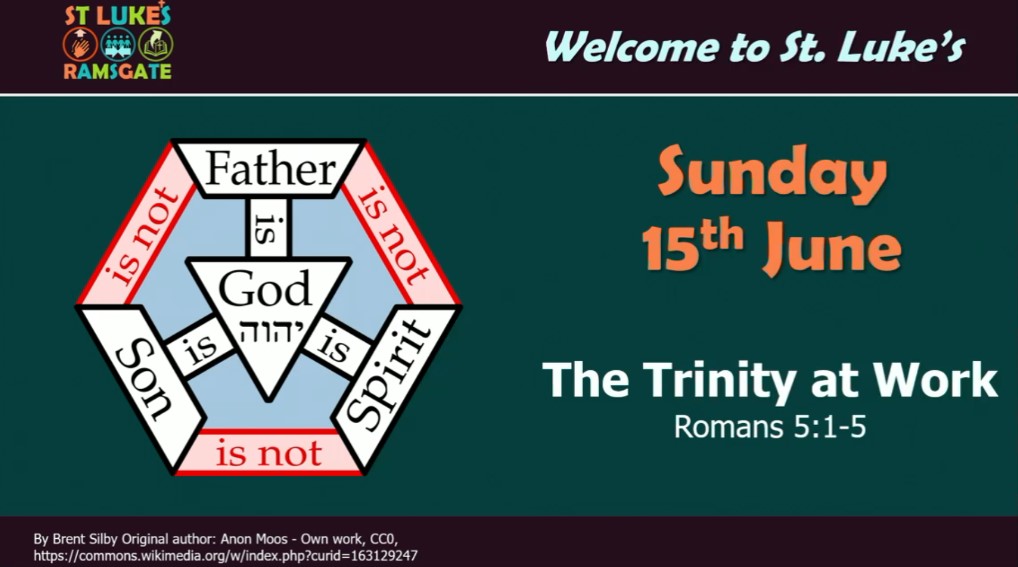
As Christians we describe God as Trinity. Three distinct persons, but one God. This is God’s essential nature. He is Father, Son and Holy Spirit. The Persons are distinct: The Father is not the Son or the Spirit, The Son is not the Father or the Spirit and the Spirit is not the Father or the Son. And yet, they are all one, sharing in the Divinity and sharing in one another’s work. This is what God is like in eternity. It is his essential nature. We call this conception of God, ‘the Essential Trinity.’
But, we do not see God’s essential nature. How can we know God is Trinity?
If you are being interviewed for a job, you can say that you are for example a team player, but it is much more persuasive and gives the interviewers a much better demonstration of your character if you can give an example of how you have worked with others in a team.
In the same way we come to know God is Trinity, through the way he works for our salvation. And it is God at work that we see in the Bible. We call this conception of God as Trinity, ‘the Economic Trinity’, the way God acts as three-persons for our salvation.
And when we look at the work of God in the Bible, we see that our salvation happens at the Father’s initiative, because he from his throne in heaven commands that things are done, by the Son’s Work, because he comes as a kind of superhero into our world to act to bring about our salvation and by the Spirit’s application, because the Spirit is sent into our hearts to bring the reality of God’s salvation to bear.
In this way, each of the three persons has their own kind of role within the economy of our salvation and yet they are united in purpose, relate to each other as persons and share with and through each other the one mission of God and the attributes of God.
The Godhead at Work:
Let’s turn to the book of Romans to see how this plays out with two examples: ‘love and peace.’
Love
We are told in 1 John, that ‘God is love.’ In other words, God values us deeply and cares about our needs. But how do we know that? How can we know that when life becomes tough and we face all kinds of problems? Let’s look at how the three persons of God work together to demonstrate the love of God to us.
The Father’s initiative – Romans 5:8a
Firstly, there is the Father’s initiative. He wanted to show us how much he loves us. The fact He loves us from heaven is good news. This is a secure, eternal love that cannot be taken away. God is faithful to his promises, he is faithful to his commitment to us, he is unchangeable in his loving commitment.
But to demonstrate his love for us, he does not just shout, ‘I love you’ from heaven, or put a big love heart in the sky, he takes the initiative to demonstrate his love.
In Romans 5:8 it says:
“But God demonstrates his own love for us in this:
While we were still sinners, Christ died for us.”
How do we know that the Father loves us, because as it says in John 3:16, he gave us his only Son. He took the initiative to act for our salvation. But the initiative meant sending his Son to work.
The Son’s Work: demonstration of love – Romans 5:8b
So, how do we know God loves us? Because His Son, Jesus Christ died on the cross for us. This was Jesus doing the work, entering into our world, living our life and making a once and for all powerful sacrifice. Dying for us. As Jesus says in John 15:13
“Greater love has no-one than this, that he lay down his life for his friends.” (John 15:13)
The cross is the great moment in history that demonstrates the love of God for us. It is an objective and powerful fact in history that we can relate to and understand. That is the moment we remember when we take the bread and the wine later on, we are reminded of the cross and so the love of God is demonstrated to us once more.
The Spirit’s application of love – Romans 5:5
But, God’s action is not just an initiative from heaven and a moment in history, it is applied to our hearts. Look at Romans 5:5:
“…God has poured out his love into our hearts by the Holy Spirit, whom he has given us.” (Romans 5:5)
As Christians we have the Holy Spirit in us, that takes the initiative and action of God the Father and the work of God the Son and pours it into our hearts, so that we can know intimately the reality of God’s love for us.
Do you see how the three persons of the Trinity, work together as one for our good? The Father’s initiative, the Son’s work and the Spirit’s application.
Peace
Let’s take another example: ‘Peace’.
In Romans 5:1 it says,
“…we have peace with God through our Lord Jesus Christ,”
The Father’s Initiative: Rom. 3:25
The book of Romans begins by emphasising that we have lost peace with God. In fact, Paul’s main argument begins:
“The wrath of God is being revealed from heaven against all the godlessness and wickedness of men who suppress the truth by their wickedness,” (Romans 1:18)
This sounds more like a situation of war, than a situation of peace. It stresses our natural state as God’s enemies, because we are all sinners.
Paul then considers whether we can change this situation by obeying the Law of God. i.e. trying to be good enough to be friends with God again. But he concludes:
“…for all have sinned and fall short of the glory of God,” (Romans 3:23)
That is the bad news: we cannot take the initiative to bring peace with God. But the good news is that God has taken the initiative.
A couple of verses later it says:
“God presented [Christ Jesus] as a sacrifice of atonement, through faith in his blood.” (Romans 3:25a)
The word atonement here means, a sacrifice to turn aside God’s wrath, taking away sin. Again, God took the initiative of sending His Son as a sacrifice to bring about peace.
Donald Trump claimed in his election campaign that he as President of the USA would bring peace to the war torn parts of the world. So far his promise is proving rather lame.
However, the fact that God’s initiative for peace came from the eternal throne of heaven, from the King of Kings, who has power far beyond that of Donald Trump, gives it an authority to say that this is peace that will last. A peace we can be confident about.
Christ’s work of reconciliation – Rom. 5:10
God the Father took the initiative, but God the Son carried out the work. The work of Christ in bringing about this peace or reconciliation with God is underlined even more a bit later in Romans 5:10:
“For if, when we were God’s enemies, we were reconciled to him through the death of his Son, how much more, having been reconciled, shall we be saved through his life!” (Romans 5:10)
Over the last few days, we have seen the terrible eruption of war between Israel and Iran. Israel attacked Iran, fearing the threat of the development of nuclear weapons, but Iran cannot let such an attack go, it needs to respond to show that such a disregard for its Sovereignty from Israel cannot stand. Israel in turn has responded to say it will punish any attacks from Iran, to show that their own people should not be attacked. The ‘sin’ of missile strikes cannot go unpunished without leaving the impression that the country is weak and so inviting attacks from others as well. Each country needs to show their ‘wrath’ at the other. In so doing, peace seems to disappear.
On the cross, Jesus sorted out the problem, by taking the wrath of God on himself. So that the justice of God was satisfied, so that peace between us and God could be possible.
Again, as we consider the cross, the work of Christ in human history, we see not only the love of God, but also the seriousness of our sin. But we also see that God’s judgement against our sin has been dealt with. So, as it says later in Romans:
“Therefore, there is now no condemnation for those who are in Christ Jesus,” (Romans 8:1)
The Spirit’s Application – Rom. 8:6
But Romans 8, goes on to tell us about the work of the Spirit in helping us to know the peace of God and to live as those at peace with God:
“The mind of sinful man is death, but the mind controlled by the Spirit is life and peace;” (Romans 8:6)
So, again the reality of the peace initiated by the Father and achieved by the Son is applied by the Spirit into our hearts and minds.
That means that to deal with the sin in our lives, we need to reflect on the work of Christ and allow the Spirit to get to work in us and ‘put to death the sin within us’:
“For if you live according to the flesh, you will die; but if by the Spirit you put to death the misdeeds of the body, you will live,” (Romans 8:13)
So, the Spirit works in our hearts to bring about the true transformation made possible by the work of Christ.
The Father’s initiative, the Son’s work and the Spirit’s ongoing application brings us peace. The Trinity at work.
What do you think God is like?
I started off by asking what you think God is like?
If your conception is focussed more on a director God, then perhaps you need to see how he works through the Son and by the Spirit, so that you can deepen your understanding of God’s activity in history and in your own heart.
If your conception is focussed more on a superhero God, then perhaps you need to remember the initiative of our heavenly Father, which can give a greater confidence of God’s power and authority, as well as the application of the Spirit and look to see how God might work in transforming your heart.
If your conception is focussed more on the spiritual God, then perhaps you need to work to make sure your faith is more grounded in the objective reality of what Christ has done and the initiative of the Father.
Let’s boast in God, as Trinity. Father, Son and Holy Spirit and rejoice more and more in what he has done for us.
 St. Luke's Church Ramsgate