“And now these three remain, faith, hope and love, but the greatest of these is love.” (1 Corinthians 13:13)
To become a father takes only a few minutes. To become a mother takes nine months of pregnancy – and that is only just the start of it!
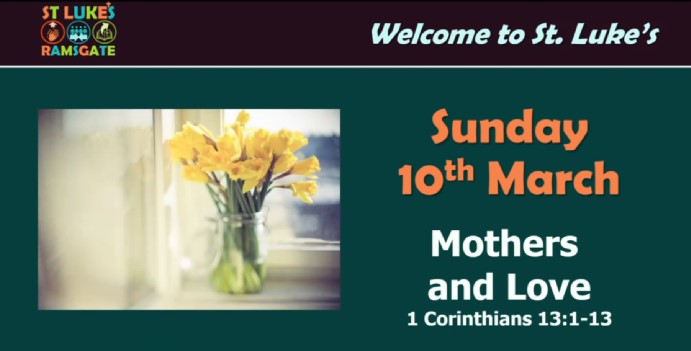
Mothers and Love
To become a father takes only a few minutes. To become a mother takes nine months of pregnancy – and that is only just the start of it!
Most of us have experienced a mothers love. No mother is perfect and some fail big time, but most show a high and counter-cultural degree of love for their children. They are willing to endure pregnancy, nights with broken sleep, endless changes of nappies, tantrums, school runs, cooking, cleaning, teaching and counselling, not for their own sakes, but for the good of their children.
Most mothers, spend a lot of their lives centred on the other, that is their children and paying the emotional and financial cost for that.
Do you know how much the estimated cost of bringing up a child from 0 to 18 is? Over £200,000!
Yet, we live in a world, where the culture is increasingly individualistic and attitudes more and more self-centred. Do what makes you feel good. Your special. Don’t be constrained by others. Follow your dreams. None of this fits well with the sacrificial love entailed in being a mother.
No wonder that the birth rate is dropping in the West. To maintain the same size of population women need to have on average 2.1 children. In the UK women are now having on average 1.58 children. That means for every 100 adults in the present parental generation, there will be only 62 grandchildren.
In South Korea, things are even worse. The average woman has 0.78 children, which means a 100 adults will have only 15 grandchildren.
Our Western society talks a lot about ‘love’, but is the reality that we are more focussed on self-centred individualism, than the kind of natural love shown by mothers to children or indeed the kind of Christian love that Paul is encouraging in 1 Corinthians 13?
Love is Other-Centred, vs. 4-7
Paul gives a list of 15 things, that love is. He starts with 2 things it is, follows that up with 7 things it is not, what love does not and does rejoice in and four things where love is never-ending.
Patient. The old word is long-suffering. In other words, it keeps going for the sake of the other, even when it is draining for us. Most Mothers do this with children, enduring years of crying, tantrums and dirty nappies, followed later by teenage sulks.
This is what God does with us in our feeble and often half-hearted efforts to live for him, he is patient with us.
Linked with this are two of the negatives:
- It is not easily angered or irritable. Patient people don’t burst into rage when others upset them.
- It keeps no record of wrongs or remain resentful. Like God forgives us, true love forgives others the wrong they do.
Also, linked with this are the last four areas, that stress that love persists:
- always protects, it never gives up finding ways to help us, just as most mothers never give up on wanting to support their children and God never gives up on supporting us.
- always trusts and hopes. It wants to think the best of others and believe that they will come good in the end.
- always endures or perseveres. Love never gives up. Just as God never gives up on us and a mother never gives up on her child.
Kind. Kindness, is about wanting to make the other person welcomed, comfortable and happy. Not wanting to upset the other, unless it is necessary for their good. Mothers want to do these things for their children and God welcomes us into his family, offering us joy and peace.
Two of the negatives are the opposite of kindness:
- It is not rude. Rudeness does not care how your behaviour makes others feel. In a way it is the opposite of kindness.
- It is not self-seeking. Self-seeking is about doing things for yourself. Love is not about that. It is about looking out for others.
Not Proud
The other three negatives are focussed on wanting to make yourself good or to feel important.
- Love is not proud or arrogant. In other words it doesn’t think of yourself as better than others or more important than others.
- Love is not boastful. It is not about trying to get everyone to think how great you are.
- Love is not envious. It is not upset when others seem to do better than you or have better things than you.
When you are envious you may be happy when others are caught out for doing wrong. That is probably what is meant by:
- It does not delight in evil or rejoice in wrongdoing. It is not happy when others prove to be wicked people, because it makes you look better.
- Instead it rejoices with the truth. Because love is not concerned with making yourself look good, it can embrace the truth and honesty about yourself even if it makes you look bad, because it may encourage and help others. It is also happy with the truth that others may be better or more successful than you, because you are concerned for others.
In all these ways, love is the opposite of self-centred, it is other-centred.
Like a good mum that is focussed on doing everything for the good growth of the child, not because the child is deserving, but because they are her child.
Like God who is focussed on doing everything for our good and our growth in Christian maturity, not because we are already good, but because he loves us and takes us in as his child
We as Christians are called to love others, to seek their good and to build them up, even when it is costly and difficult to do so. Not for our good, but there good.
This already answers the two questions from the group on our notice sheet:
- How do we continue to serve with love when provoked?
By mimicking the love of God in Jesus Christ. He died for us even when we were still sinners. He loved us not because we are lovable, not because of what we can do for him. He loved us even though it meant dying on the cross.
If we are struggling to serve others, because they are upsetting us, then we need to remind ourselves of God’s love for us and remember that true love is not easily angered and keeps no record of wrongs. Love is patient.
- What stops us from showing love to everyone regardless?
If love is not self-centred, then we do not love people only because they matter more to us, because they are our family or part of our friendship group or are inately loveable. We love them for their own good, even when we gain nothing in return. The secret to loving everyone regardless is to understand love as being divorced from our own personal gain.
Jesus said, “This is how you will know that you are my disciples – if you love one another.” Let’s work and pray for our churches to be marked by love above everything else.
________________________________________________________________
Paul’s description of love in verses 4-7 does not come, because he was preaching at a mothering Sunday service. His concern was not to give thanks for mothers or encourage good mothering. Neither was he writing particularly with married couples in mind, even though this is a popular passage to be used at weddings and it is important for married couples to learn to be other-focussed if their relationship is to flourish.
1 Corinthians 13, is not a standalone piece of beautiful literature, it is part of this letter to the Corinthians we have been looking at. It stands out from the rest of the letter as a beautiful rhetorical flourish, but it is also at the heart of Paul’s overall challenge to the Corinthian church.
Paul wants to say to the Corinthians, that this kind of love, he describes in the centre of the chapter is both essential and eternal. This is what should mark out our church life together. As he says in 8:1: “Knowledge puffs up, but love builds up!” and in 16:14 “Do everything in love.”
Love is Essential for Church Life, vs. 1-3
In the first three verses, Paul underlines how essential love is to church life.
Next week, we are going to go backwards to chapter 12. Both chapters 12 and 14 talk about the spiritual gifts that church members may have and how they should be used to build up others and in the context of church meetings.
Paul does not want to stop the use of spiritual gifts, but he wants to challenge the attitudes with which they are being used in the Corinthian church. Without an underlying attitude of love such gifts or indeed any church activity become pointless and useless. No matter how wonderful, amazing or spiritually spectacular the Christian ministry are gifts are, if they are not done in love, in order to build up others, then they are pointless.
So an important question to ask ourselves, in everything we do, is am I doing it for the good of others, with patience and kindness, celebrating what is good about them, wanting to help them in their needs and sharing the good news about Jesus with them so that they might be saved, or am I doing it for more self-centred reasons, to preserve the buildings or style of worship I value, to make myself look good or feel important because of the role I am taking on or the gift I am using.
If we want to be more than a clashing cymbal or nothing or gain nothing, then we need to make sure that an attitude of love is at the heart of it all. Love is essential for church life – the Corinthians had not fully grasped that and we need to keep asking ourselves, whether we have.
Love is Eternal, vs. 8-13
Finally, love is eternal. In verses 8-13, Paul wants us to look at our lives and activities from the time after Jesus returns and we are raised with resurrection bodies to live with God face to face for ever more. Then things will be transformed.
This is the point of the child – adult analogy. We speak, think and reason differently as adults than we did when we were children, because we have grown up, where as once we only had a small vocabulary to express ourselves, now we have a full one, where as once we could only just begin to count, now we are able to handle money effectively. As adults, our knowledge and understanding is on a different level to what it was as children.
It is also the point of the mirror analogy. Corinth was famous for bronze mirrors, that could give a reasonably decent reflection. Yet, even such reflections were not the same as looking at someone directly. Some of the details are obscured. We don’t see or understand as clearly as we can when we see face to face.
The Corinthians valued, knowledge and understanding great mysteries. They looked up to Christians who seemed to have more knowledge of these things and perhaps felt that such knowledge was the key to being closer to God.
They also valued spiritual gifts that seemed to help reveal this mysterious spiritual knowledge of God: prophecy, tongues and imparting special knowledge. But Paul says, in eternity, we will see God face to face, we will all have complete knowledge. When that happens, the spiritual gifts of prophecy, tongues and imparting special knowledge will become obsolete, no longer any use. What they may offer in part now, will be fully known by us all then.
What will remain important, however, is love. Because that concern and action for the other is at the heart of God’s eternal nature. When people ask what will heaven be like, the answer is it will be a community of perfect love.
As the church today, we want to reflect something of that eternal kingdom. The main way we do that is by living as people of love.
In our year of discernment let us remember that calling above all.
 St. Luke's Church Ramsgate
yes!!! Love is the key!!! The answer!!! Our salvation from hell!!! The LOVE of our father in heaven!!! Thank you, Lord for loving me!!!🙏💕🧚
LikeLike