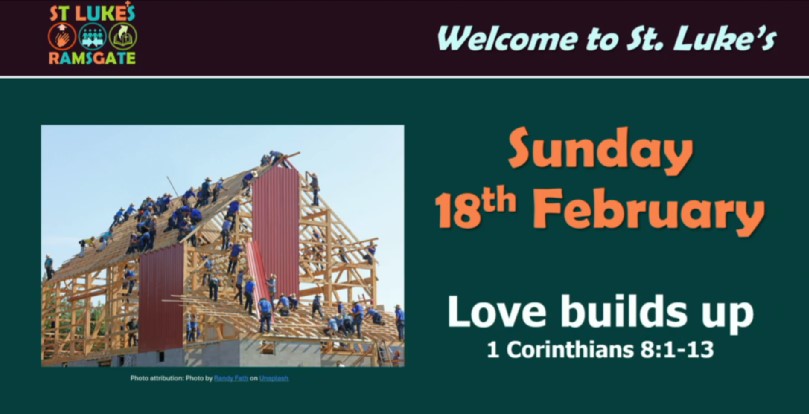
“Knowledge puffs up, but love builds up.” (1 Corinthians 8:1)
Paul shows that love is the eternal value that builds up Christ’s church. When we grasp this, then knowledge can be used for building up others rather than justifying our own freedoms and pride.
Constructing the Church
As Christians we claim to follow a creator God, a God who brings order out of chaos. We are called to construction not destruction. We are called to build something special – not buildings, although they have their place, but people of faith and a community of faith.
Today we are back looking at the letter of Paul to the Corinthians written in the 50s AD. It is a letter that is a plea for people to stop behaving in ways that are destructive to the Christian community and to start working to build it up.
That is what Paul saw himself doing. He says, earlier in the letter, in 1 Corinthians 3:9-11:
“For we are God’s fellow-workers; you are God’s field, God’s building. By the grace God has given me, I laid a foundation as an expert builder, and someone else is building on it. But each one should be careful how he builds. For no-one can lay any foundation other than the one already laid, which is Jesus Christ.” (1 Corinthians 3:9-11)
Jesus Christ is the foundation. Out of love for us, he forego his rights as the Son of God and died a sacrificial death on the cross, in order to offer us forgiveness, a new start and eternal life. It is through faith in his work, that we find salvation and a place as one of his people, a place in his church.
His life, death and resurrection, laid the foundation for the church, a church which by His Spirit and through his people he has continued to build over Millenia and around the world.
This is a church, which as it has preached and lived out the values of Christ it has helped to construct a better world, yet also looks forward to being a part of God’s ultimate construction of a new heaven and new earth, where finally all the decay and destruction of our present world will be no more.
The Year of Discernment and 1 Corinthians 8-14
We Christians here in Ramsgate, just like the Christians in Corinth in the 50s AD are a small part of the bigger church. But we are still called to be a part of that great construction project in this place.
St. Luke’s and St. George’s are making 2024 a year of discernment, when we want to seek God’s guidance and direction for the years ahead, for how we may go about building up his church in this place.
So, over Lent, we are going to be looking together at these central chapters in 1 Corinthians, chapters 8-14, to help us as we reflect on God’s call.
What holds these chapters together is the Christian attitude of love – a love that builds up. It builds up both individual Christians and also the community of Christians, the church. But it Christian love, by its nature, is sacrificial. In particular, these chapters emphasise that love leads us to forego our rights for the sake of protecting and building up the church and others.
But these chapters also contain the flipside, warnings that when we insist on our rights and ignore the needs of others, we cause untold damage to the church and its members.
This theme is worked out across a number of different issues. Some seem obscure to us and are specific to the time and place of 50s AD Corinth, but nonetheless as we look at what Paul has to say about them, we understand more clearly this key theme of love that foregoes one’s rights to build up the church.
So:
- Chapters 8, 10 look at meat sacrificed to idols. For us that feels like an obscure issue, but the principles Paul articulates are important for us to grasp today and we’ll see how it introduces this theme of love foregoing rights.
- In chapter 9, Paul describes his own behaviour and attitudes in foregoing his rights for the sake of building up the church
- In chapter 11, he criticises those who use their spiritual gifts without concern for authority structures and those who partake in communion services without concern for the poorer among them. We are to act out of love for others, not out of a desire to make the most of our freedoms for our benefits.
- Chapter 12 focuses on spiritual gifts, but with an encouragement to use Spiritual gifts for building up others and valuing the part everyone has to play.
- Then in chapter 13, the climax of this whole section is a description of love as the eternal value.
- Finally, Paul concludes this whole section in chapter 14, by insisting that people willingly submit to order at their meetings out of a concern for the building up of others.
As we go through these chapters in Lent, we are going to try something a bit different. The study groups are going to look at the passage that will be preached on in the week before it is preached. They will reflect on it with some fairly open ended questions and in the light of their studies reflect on what God might be saying to us as churches as we seek to discern where God is leading us. Those thoughts will be fed back to the preacher, who will then use and refer to some of them in the following week’s sermon, whilst all the comments will feed into the ongoing discernment process.
That’s the plan and in choosing the sections of these chapters we are going to look at, I’ve tried to avoid the more obscure ones! However, this week, before we start that process, I want to quickly tackle the issue of food sacrificed to idols, that perhaps feels most obscure for us today.
Food Sacrificed to Idols
As we read letters like 1 Corinthians one of our difficulties is that we are listening to one side of a conversation. At the start of chapter 7, Paul says, ‘Now about the matters you wrote about…’ In other words part of the point of this letter is to respond to a letter from the Corinthians, which had clearly raised a number of issues.
Perhaps the question Paul is responding to here is:
“Was it OK to eat food that was sacrificed to idols?”
Paul’s answer is far from simple. In fact if you read chapters 8 and 10, he gives three contradictory answers:
“No, if…” in 8:13
“No way!!” in 10:14-21
“Yes.” in 10:25-27
Why three different answers? Probably because of three different settings.
In this passage Paul talks of two groups, ‘the weak’ and ‘the strong’. ‘The strong’ saw themselves as having superior knowledge to the weak. They were probably wealthier and better educated and maybe grasped and understood the Christian teaching more fully.
But also, as the wealthy they were probably – at least before becoming Christians – used to eating meat regularly.
There were three settings where they would have done this:
One setting was as part of idol worship. This is probably the setting Paul is referring to in 10:14-21. Paul says, this is definitely not on, as you cannot be involved in worshipping idols as well as worshipping Christ.
The idols may not be real gods, but people treat them as ‘Lords’ nonetheless. If you treat them as a real god, then you are not allowing Christ to be the one true Lord in your life. As Jesus said, when speaking about money as an idol, ‘You cannot serve both God and Money.” So, when it came to eating meat as part of idol worship, Paul says, ‘No way!’ ‘Flee idolatry!’
In contrast at the end of chapter 10, Paul is talking about eating meat at home, when it had been bought in the market place. Here the meat may or may not have been sacrificed to an idol before being sold. But as Paul accepts, what you eat does not matter to God. Food is not contaminated by being sacrificed to an idol. So, you are free to eat it in your own home, without worrying whether it has come through the temple.
However, the context of chapter 8, is a different setting again. Here it is about eating meat in an idol temple. This seems not to be as part of actual idol worship, but it was common for dinner parties and civic events to happen in temple buildings, using the meat that had been part of idol worship.
So was this situation alright? Paul does not lay down a set of rules and regulations, he is more concerned to explain key principles and values that arise from the good news about Jesus, that we are to live by.
Knowledge puffs up and justifies rights
In the first verse, Paul says, ‘Knowledge puffs up.’
The strong felt that they were free to continue eating meat, even though most meat was sacrificed to idols in temples, because as Paul accepts they knew that idols are nothing. There is only one God. This knowledge, they felt left them free to eat whatever they wanted.
Certainly, when we come to have knowledge about God, we do discover freedom from superstitions, fears and guilt that may otherwise enslave us. We no longer need to work for some kind of salvation, by following rules or regulations, because God has done everything in Christ to win our salvation. That is wonderful knowledge to have and it is liberating.
Paul agrees with the strong. Idols are nothing. What you eat does not matter. As Christians we are free to eat meat, without worrying about it being tainted by idol worship.
BUT for Paul this is not the whole picture. If our knowledge just leads to us asserting our rights and freedoms without concern about its effects on others, then we become puffed up and arrogant. In fact, Paul concludes at the end of chapter 8, that such an attitude is ultimately destructive.
Why? Because although the strong may be confident, there is nothing wrong with eating meat sacrificed to idols in an idol temple and in their own minds can distinguish the eating of meat from idol worship, the weak, those who don’t fully grasp this knowledge, but are nevertheless Christian brothers and sisters, may be led by the example of the strong – especially if they see them eating in the temple precincts, to eat idol meat, without being able to distinguish the eating of such meat from actual idol worship. As such they are in their own minds led into idol worship, their conscience is damaged, their faith is destroyed.
Paul is saying to the strong, your knowledge may set you free, but how can you use your freedom in a way that will lead to the destruction of a brother or sister in Christ?
Love builds up and foregoes rights
So, Paul says, we have rights as Christians, but there are times that we need to forego those rights.
In verse 13, he says, that if eating meat causes a brother or sister to fall into sin. He will never eat meat again. Out of love for his brothers and sisters in Christ, he is willing to forego his rights, to avoid their destruction.
Paul, then goes on to give other examples in chapter 9 of how he foregoes his rights or freedoms in order to build up the church, the community of Christians and to avoid tearing it down. But that’s for next week!
Paul uses himself as an example, but he ultimately brings us back to Christ. In 11:1 at the end of the discussion about meat sacrificed to idols, he says, “Follow my example, as I follow the example of Christ.”
If our faith is founded on the ultimate act of love, which involved Jesus giving up His rights as the Son of God to die on the cross, for our salvation and to build God’s people, the church, then should we not forego our rights and freedoms for the sake of the protection of the faith of others and the building up of Christ’s church.
Are you about construction or freedom?
So, are you about building something eternal or about your own personal freedom?
Are you concerned with the growth in faith of those around you and careful to avoid anything that might make them fall?
What rights or freedoms do you need to give up, to help protect and build up the faith of others around you?
 St. Luke's Church Ramsgate